
Ch. 5 - Chemical Reaction Analysis: Thermodynamics and Kinetics
Mullins - Organic Chemistry: A Learner Centered Approach 1st Edition
Mullins1st EditionOrganic Chemistry: A Learner Centered ApproachISBN: 9780137566471Not the one you use?Change textbook
Chapter 4, Problem 72c

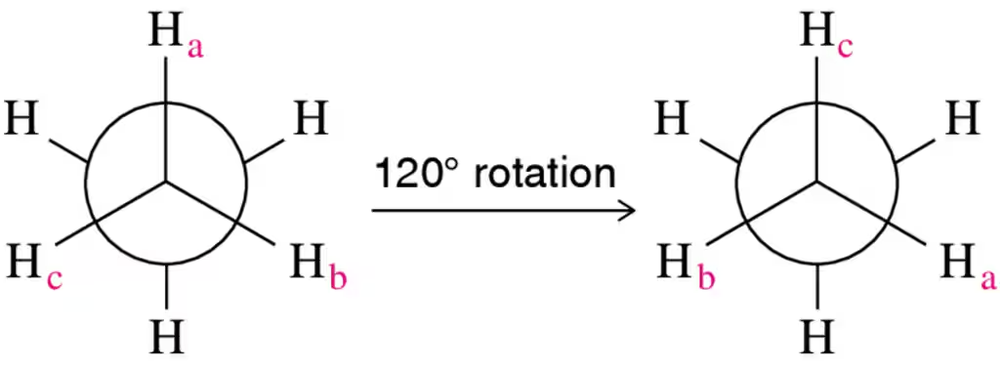
Parts (a)–(f) of this assessment refer to the rotation around the single bond of ethane.

(c) Write the rate law for this reaction.

Verified step by step guidance
1
Understand the context: The problem refers to the rotation around the single bond of ethane. This process involves overcoming a small energy barrier due to torsional strain caused by the eclipsing of hydrogen atoms. The rate law will describe how the rate of this rotation depends on relevant factors.
Identify the factors affecting the rate: The rotation around the single bond in ethane is influenced by temperature and the energy barrier (activation energy). Since this is a molecular process, the rate law will likely depend on the concentration of ethane molecules.
Recall the general form of a rate law: A rate law is expressed as \( \text{Rate} = k \cdot [\text{Reactant}]^n \), where \( k \) is the rate constant, \( [\text{Reactant}] \) is the concentration of the reactant, and \( n \) is the reaction order.
Determine the reaction order: For the rotation around the single bond of ethane, the process is unimolecular (involving a single molecule of ethane). Therefore, the reaction order is typically first-order, meaning \( n = 1 \).
Write the rate law: Using the general form and the information above, the rate law for the rotation around the single bond of ethane can be expressed as \( \text{Rate} = k \cdot [\text{C}_2\text{H}_6] \), where \( [\text{C}_2\text{H}_6] \) represents the concentration of ethane.

Verified video answer for a similar problem:

This video solution was recommended by our tutors as helpful for the problem above.
Video duration:
3m
Was this helpful?

Key Concepts

Here are the essential concepts you must grasp in order to answer the question correctly.

Rate Law

The rate law is an equation that relates the rate of a chemical reaction to the concentration of its reactants. It is typically expressed in the form Rate = k[A]^m[B]^n, where k is the rate constant, [A] and [B] are the concentrations of the reactants, and m and n are the reaction orders. Understanding the rate law is essential for predicting how changes in concentration affect the speed of the reaction.
Recommended video:
5:07
Rates of Intramolecular Reactions Concept 2

Single Bond Rotation

Single bond rotation refers to the ability of atoms connected by a single bond to rotate freely around that bond axis. In ethane, this rotation can lead to different conformations, which can influence the energy and stability of the molecule. Recognizing how this rotation affects molecular interactions is crucial for understanding reaction mechanisms and kinetics.
Recommended video:
Guided course
06:00
Single bonds, double bonds, and triple bonds.

Ethane Conformation

Ethane can exist in various conformations due to the rotation around its C-C single bond, primarily staggered and eclipsed forms. The staggered conformation is more stable due to minimized steric hindrance, while the eclipsed conformation is less stable. The stability of these conformations can impact the reaction pathway and the rate at which the reaction occurs, making it important for analyzing the rate law.
Recommended video:
Guided course
03:29
Understanding what a conformer is.