
The halogenation of an alkane when there is an alkene present in the molecule does not proceed with the regioselectivity you might expect. Using principles similar to those developed in this chapter, rationalize the formation of A as the only product. We study this reaction further in Chapter 8.
Ch. 5 - Chemical Reaction Analysis: Thermodynamics and Kinetics

Mullins1st EditionOrganic Chemistry: A Learner Centered ApproachISBN: 9780137566471Not the one you use?Change textbook
All textbooks
Mullins 1st Edition
Ch. 5 - Chemical Reaction Analysis: Thermodynamics and Kinetics
Problem 72b
Mullins 1st Edition
Ch. 5 - Chemical Reaction Analysis: Thermodynamics and Kinetics
Problem 72bChapter 4, Problem 72b
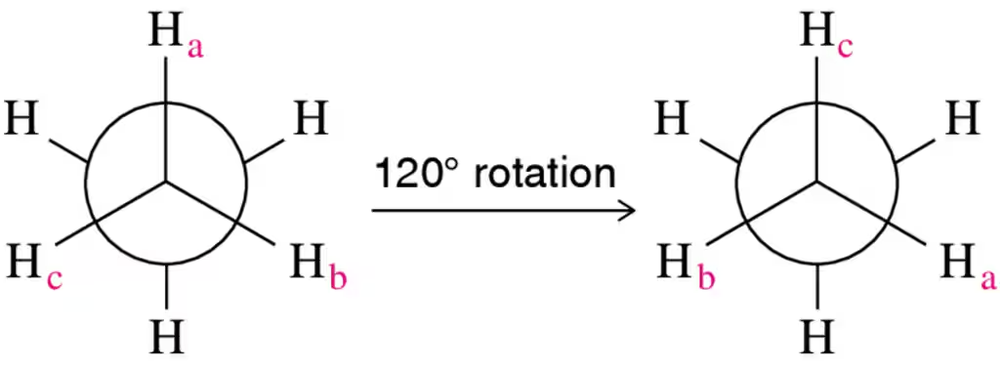
Parts (a)–(f) of this assessment refer to the rotation around the single bond of ethane.

(b) What is the order of the reaction with regard to ethane?
Verified step by step guidance1
Understand the context of the problem: The question refers to the rotation around the single bond in ethane (C₂H₆). This involves the concept of conformational analysis, which studies the spatial arrangement of atoms due to rotation about single bonds.
Recall that the rotation around a single bond in ethane is not a chemical reaction but a physical process. The energy barrier for this rotation arises from torsional strain due to the repulsion between electron clouds in the bonding orbitals of adjacent hydrogens.
Recognize that the term 'order of reaction' typically applies to chemical reactions and describes how the rate of a reaction depends on the concentration of reactants. Since this problem involves rotation around a single bond, it is not a chemical reaction, and the concept of reaction order does not directly apply.
If the question is asking about the energy profile of the rotation, consider the potential energy diagram for ethane. The energy varies as the molecule rotates, with staggered conformations being at energy minima and eclipsed conformations at energy maxima.
Conclude that the question may be testing your understanding of the distinction between physical processes (like bond rotation) and chemical reactions. Clarify that the concept of reaction order is not relevant to the rotation of ethane's single bond.

Verified video answer for a similar problem:
This video solution was recommended by our tutors as helpful for the problem above.
Video duration:
2mWas this helpful?
Key Concepts
Here are the essential concepts you must grasp in order to answer the question correctly.
Single Bond Rotation
Single bond rotation refers to the ability of atoms connected by a single bond to rotate freely around that bond. In ethane, this rotation leads to different conformations, such as staggered and eclipsed forms, which can influence the molecule's stability and energy. Understanding this concept is crucial for analyzing the dynamics of ethane and its reactivity.
Recommended video:
Guided course
Single bonds, double bonds, and triple bonds.
Reaction Order
Reaction order is a term used in chemical kinetics to describe the relationship between the concentration of reactants and the rate of a reaction. It is determined by the sum of the powers of the concentration terms in the rate law. For ethane, understanding its reaction order helps in predicting how changes in concentration affect the reaction rate.
Recommended video:
Guided course
Proper name ordering and punctuation
Kinetics of Ethane Reactions
The kinetics of ethane reactions involves studying how the molecular structure and bond rotations influence the speed and mechanism of chemical reactions. Ethane, being a simple alkane, often undergoes reactions that can be analyzed through its rotational conformations, which can affect the activation energy and transition states during reactions.
Recommended video:
Guided course
Kinetic vs. Thermodynamic Control
Related Practice
Textbook Question
1
views
Textbook Question
When a student attempted a bromination to produce compound A, they generated compound B instead. Rationalize the formation of B using the arrow-pushing formalism.
2
views
Textbook Question
Parts (a)–(f) of this assessment refer to the rotation around the single bond of ethane.
(c) Write the rate law for this reaction.
1
views
Textbook Question
Parts (a)–(f) of this assessment refer to the rotation around the single bond of ethane.
(a) Given that the rate of the reaction is independent of concentration, fill in the missing rates in the following table.
1
views
Textbook Question
For rotation around a bond, the rate constant is equal to the reaction rate. Why?
1
views