Ch. 5 - Chemical Reaction Analysis: Thermodynamics and Kinetics
Mullins - Organic Chemistry: A Learner Centered Approach 1st Edition
Mullins1st EditionOrganic Chemistry: A Learner Centered ApproachISBN: 9780137566471Not the one you use?Change textbook
Chapter 4, Problem 19

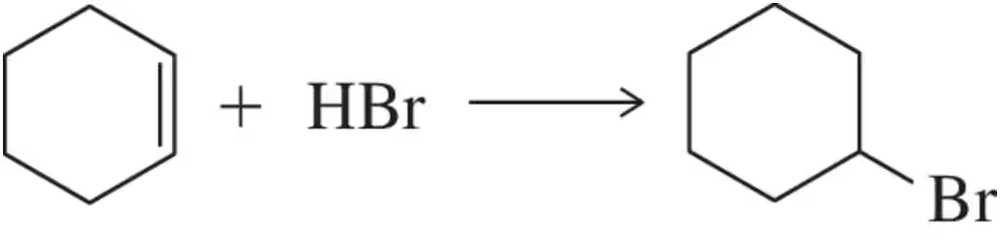
If the following reaction is favorable, what can we say about the sign of ∆H°? Explain your answer.
Chemical reaction diagram showing a hexagonal structure reacting with HBr to form a brominated hexagonal compound.

Verified step by step guidance
1
Step 1: Understand the concept of enthalpy change (∆H°). ∆H° represents the change in enthalpy (heat content) during a chemical reaction under standard conditions. It indicates whether a reaction absorbs or releases heat.
Step 2: Recall the relationship between reaction favorability and ∆H°. A reaction is considered favorable if it proceeds spontaneously under given conditions. While spontaneity is primarily determined by Gibbs free energy (∆G°), ∆H° plays a role in determining ∆G° along with entropy (∆S°).
Step 3: Consider the sign of ∆H° for favorable reactions. If a reaction releases heat (exothermic), ∆H° is negative, which often contributes to making the reaction favorable. Conversely, if a reaction absorbs heat (endothermic), ∆H° is positive, but the reaction can still be favorable if entropy changes significantly.
Step 4: Analyze the context of the problem. Since the question asks about the sign of ∆H° for a favorable reaction, we can infer that a negative ∆H° (exothermic reaction) is more likely to contribute to favorability, as it lowers the energy of the system.
Step 5: Conclude that for a favorable reaction, the sign of ∆H° is typically negative, but it is important to consider other factors like entropy and temperature that influence the overall spontaneity (∆G°).

Verified video answer for a similar problem:

This video solution was recommended by our tutors as helpful for the problem above.
Video duration:
4m
Was this helpful?

Key Concepts

Here are the essential concepts you must grasp in order to answer the question correctly.

Enthalpy Change (∆H°)

Enthalpy change (∆H°) is a measure of the heat content of a system at constant pressure. A negative ∆H° indicates that a reaction releases heat (exothermic), while a positive ∆H° signifies that the reaction absorbs heat (endothermic). Understanding the sign of ∆H° is crucial for predicting the favorability of a reaction, as exothermic reactions are generally more favorable.
Recommended video:
Guided course
04:38
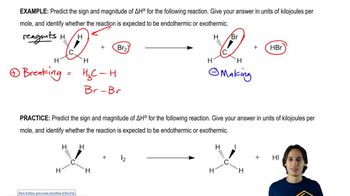
Calculating Enthalpies

Gibbs Free Energy (∆G)

Gibbs Free Energy (∆G) combines enthalpy and entropy to determine the spontaneity of a reaction. A reaction is considered favorable (spontaneous) when ∆G is negative. The relationship between ∆G, ∆H, and entropy (T∆S) is given by the equation ∆G = ∆H - T∆S, where T is the temperature in Kelvin. This concept is essential for understanding how enthalpy influences reaction favorability.
Recommended video:
Guided course
05:02
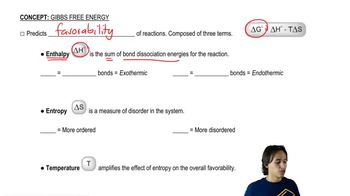
Breaking down the different terms of the Gibbs Free Energy equation.

Thermodynamic Favorability

Thermodynamic favorability refers to the likelihood of a reaction occurring under standard conditions. A reaction is thermodynamically favorable if it leads to a decrease in free energy (negative ∆G). This often correlates with a negative ∆H° for exothermic reactions, suggesting that heat is released, which can drive the reaction forward. Understanding this concept helps in predicting the behavior of chemical reactions.
Recommended video:
Guided course
08:51
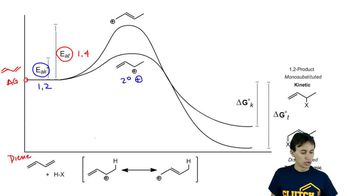
Kinetic vs. Thermodynamic Control