Ch. 5 - Chemical Reaction Analysis: Thermodynamics and Kinetics
Mullins - Organic Chemistry: A Learner Centered Approach 1st Edition
Mullins1st EditionOrganic Chemistry: A Learner Centered ApproachISBN: 9780137566471Not the one you use?Change textbook
Chapter 4, Problem 18c

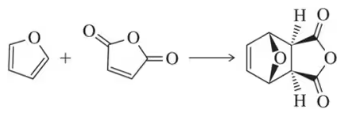
For each of the following processes, indicate whether you expect ∆S° to be greater than, less than, or equal to 0. Explain your answer.
(c)

Verified step by step guidance
1
Analyze the chemical reaction: The image shows two reactants combining to form a single product. This is a condensation reaction where two molecules are forming a larger, more complex molecule.
Consider the change in the number of particles: In the reactants, there are two separate molecules, while in the product, there is only one molecule. This reduction in the number of particles typically leads to a decrease in entropy (∆S° < 0).
Evaluate molecular complexity: The product is more structurally complex than the reactants. Increased molecular complexity often corresponds to a decrease in entropy because the product has fewer degrees of freedom compared to the reactants.
Assess the phase of the reaction: If the reaction occurs in the same phase (e.g., all species are in the liquid phase), the entropy change is primarily influenced by the reduction in the number of particles and the increase in molecular complexity.
Conclude the entropy change: Based on the reduction in the number of particles and the increase in molecular complexity, ∆S° is expected to be less than 0 (negative).

Verified video answer for a similar problem:

This video solution was recommended by our tutors as helpful for the problem above.
Was this helpful?

Key Concepts

Here are the essential concepts you must grasp in order to answer the question correctly.

Entropy (∆S°)

Entropy, denoted as ∆S°, is a measure of the disorder or randomness in a system. In thermodynamics, a positive change in entropy (∆S° > 0) indicates an increase in disorder, while a negative change (∆S° < 0) suggests a decrease in disorder. Understanding how molecular arrangements and states of matter affect entropy is crucial for predicting the sign of ∆S° in various processes.
Recommended video:
Guided course
02:46
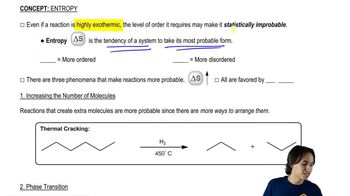
Explaining what entropy is.

Phase Changes

Phase changes, such as melting, boiling, or sublimation, significantly influence entropy. For example, when a solid melts into a liquid, the molecules become more disordered, leading to an increase in entropy (∆S° > 0). Conversely, when a gas condenses into a liquid, the molecules become more ordered, resulting in a decrease in entropy (∆S° < 0). Recognizing the phase of substances involved in a process is essential for determining the sign of ∆S°.
Recommended video:
1:53
Merrifield Solid-Phase Peptide Synthesis Concept 1

Molecular Complexity

The complexity of molecules, including the number of atoms and the types of bonds, affects entropy. More complex molecules with greater degrees of freedom (e.g., rotational and vibrational modes) typically have higher entropy than simpler molecules. When analyzing a process, considering the molecular structures and their interactions can help predict whether the overall entropy change will be positive or negative.
Recommended video:
Guided course
05:02
Coordination Complexes