Ch. 5 - Chemical Reaction Analysis: Thermodynamics and Kinetics
Mullins - Organic Chemistry: A Learner Centered Approach 1st Edition
Mullins1st EditionOrganic Chemistry: A Learner Centered ApproachISBN: 9780137566471Not the one you use?Change textbook
Chapter 4, Problem 24f

For the following acid–base reaction, (f) calculate ∆G° at 373 K.

Verified step by step guidance
1
Identify the acid and base in the reaction and determine the pKa values of the acid and conjugate acid. This will help in calculating the equilibrium constant (K).
Use the relationship between the equilibrium constant (K) and the pKa values: \( K = 10^{\text{pKa (acid)} - \text{pKa (conjugate acid)}} \). Substitute the appropriate pKa values into this equation to calculate K.
Recall the relationship between the standard Gibbs free energy change (\( \Delta G^\circ \)) and the equilibrium constant: \( \Delta G^\circ = -RT \ln K \), where \( R \) is the gas constant (8.314 J/mol·K) and \( T \) is the temperature in Kelvin (373 K in this case).
Substitute the calculated value of \( K \), the gas constant \( R \), and the temperature \( T \) into the equation \( \Delta G^\circ = -RT \ln K \). Ensure that the units are consistent (e.g., \( R \) in J/mol·K and \( T \) in Kelvin).
Simplify the expression to calculate \( \Delta G^\circ \). This will give the standard Gibbs free energy change for the reaction at 373 K.

Verified video answer for a similar problem:

This video solution was recommended by our tutors as helpful for the problem above.
Video duration:
3m
Was this helpful?

Key Concepts

Here are the essential concepts you must grasp in order to answer the question correctly.

Gibbs Free Energy (∆G)

Gibbs Free Energy (∆G) is a thermodynamic potential that measures the maximum reversible work obtainable from a thermodynamic system at constant temperature and pressure. It is a crucial concept in predicting the spontaneity of a reaction; a negative ∆G indicates a spontaneous process, while a positive ∆G suggests non-spontaneity. The standard Gibbs free energy change (∆G°) is calculated under standard conditions, providing a reference point for reactions.
Recommended video:
Guided course
05:02
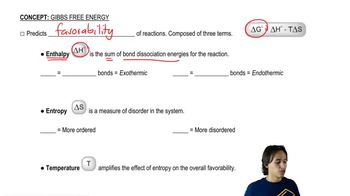
Breaking down the different terms of the Gibbs Free Energy equation.

Acid-Base Reactions

Acid-base reactions involve the transfer of protons (H⁺ ions) between reactants. In these reactions, acids donate protons, while bases accept them. Understanding the strength of acids and bases, as well as their dissociation constants (Ka and Kb), is essential for calculating the equilibrium position and the Gibbs free energy change associated with the reaction.
Recommended video:
Guided course
02:49
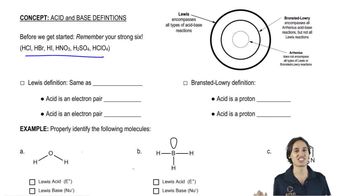
The Lewis definition of acids and bases.

Temperature Dependence of ∆G

The Gibbs free energy change (∆G) is temperature-dependent, and its calculation at different temperatures requires consideration of the enthalpy (∆H) and entropy (∆S) changes of the reaction. The relationship is given by the equation ∆G = ∆H - T∆S, where T is the absolute temperature in Kelvin. At 373 K, it is important to accurately determine ∆H and ∆S to compute ∆G°, reflecting how temperature influences the spontaneity of the reaction.
Recommended video:
1:44
Polymers Structure and Properties Concept 3