Ch. 5 - Chemical Reaction Analysis: Thermodynamics and Kinetics
Mullins - Organic Chemistry: A Learner Centered Approach 1st Edition
Mullins1st EditionOrganic Chemistry: A Learner Centered ApproachISBN: 9780137566471Not the one you use?Change textbook
Chapter 4, Problem 25c

Calculate ∆G°, ∆H°, and ∆S° for the following acid–base reactions. Rationalize the value of ∆H° based on the structure of the conjugate bases. [Assume T = 298 K.]
(c) Chemical equation showing the reaction between hydronium ion and bromide ion to form water and hydrobromic acid.

Verified step by step guidance
1
Step 1: Begin by identifying the acid and base in the given reaction. Write the chemical equation for the acid-base reaction, including the conjugate acid and conjugate base formed.
Step 2: Use the relationship between Gibbs free energy (∆G°), enthalpy (∆H°), and entropy (∆S°) given by the equation: G=H-TS. Rearrange this equation to solve for any missing variable if needed.
Step 3: To calculate ∆G°, use the equilibrium constant (K) for the reaction and the equation: G=-RTlnK, where R is the gas constant (8.314 J/mol·K) and T is the temperature in Kelvin (298 K).
Step 4: Rationalize the value of ∆H° by analyzing the structure of the conjugate bases. Consider factors such as resonance stabilization, electronegativity, and bond strength in the conjugate bases to explain why the enthalpy change occurs.
Step 5: Calculate ∆S° using the relationship S=(H-G)/T. Ensure all values are in consistent units (e.g., J or kJ) before performing the calculation.

Verified video answer for a similar problem:

This video solution was recommended by our tutors as helpful for the problem above.
Video duration:
9m
Was this helpful?

Key Concepts

Here are the essential concepts you must grasp in order to answer the question correctly.

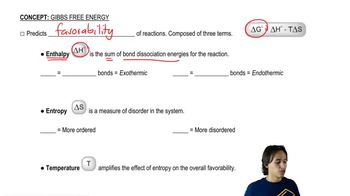
Gibbs Free Energy (∆G°)

Gibbs Free Energy (∆G°) is a thermodynamic potential that measures the maximum reversible work obtainable from a thermodynamic system at constant temperature and pressure. It is crucial for predicting the spontaneity of a reaction; a negative ∆G° indicates a spontaneous process, while a positive value suggests non-spontaneity. The relationship between ∆G°, enthalpy (∆H°), and entropy (∆S°) is given by the equation ∆G° = ∆H° - T∆S°, where T is the temperature in Kelvin.
Recommended video:
Guided course
05:02
Breaking down the different terms of the Gibbs Free Energy equation.

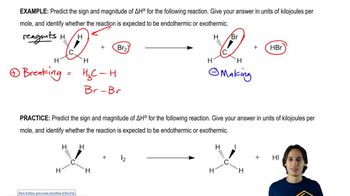
Enthalpy (∆H°)

Enthalpy (∆H°) is a measure of the total heat content of a system and reflects the energy changes during a chemical reaction. It can be either exothermic (releasing heat, ∆H° < 0) or endothermic (absorbing heat, ∆H° > 0). The value of ∆H° can be rationalized by examining the stability and structure of the reactants and products, particularly the strength of bonds broken and formed, which influences the overall energy change.
Recommended video:
Guided course
04:38
Calculating Enthalpies

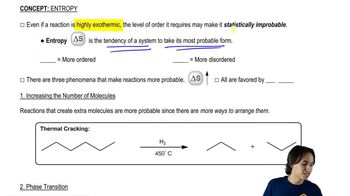
Entropy (∆S°)

Entropy (∆S°) is a measure of the disorder or randomness in a system. In chemical reactions, an increase in entropy (∆S° > 0) typically favors spontaneity, as systems tend to evolve towards greater disorder. The change in entropy can be influenced by factors such as the number of molecules, phase changes, and the complexity of the molecular structures involved in the reaction, which are essential for understanding the thermodynamic favorability of acid-base reactions.
Recommended video:
Guided course
02:46
Explaining what entropy is.