Ch. 4 - Acids and Bases: Electron Flow
Mullins - Organic Chemistry: A Learner Centered Approach 1st Edition
Mullins1st EditionOrganic Chemistry: A Learner Centered ApproachISBN: 9780137566471Not the one you use?Change textbook
Chapter 3, Problem 70c

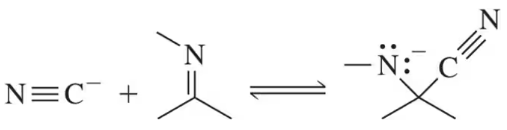
Using pKa values for the conjugate acids of the bases on each side of the reaction arrow, identify which side of the equilibrium would be favored in the following hypothetical reactions.
(c)

Verified step by step guidance
1
Step 1: Identify the bases and their conjugate acids on both sides of the equilibrium. On the left side, the base is the cyanide ion (N≡C⁻), and its conjugate acid is hydrogen cyanide (HC≡N). On the right side, the base is the deprotonated form of the imine (N⁻ with lone pairs), and its conjugate acid is the protonated imine.
Step 2: Look up the pKa values for the conjugate acids of the bases. The pKa of hydrogen cyanide (HC≡N) is approximately 9.2, and the pKa of the protonated imine is typically lower, around 4-5, depending on the specific structure.
Step 3: Compare the pKa values. The side of the equilibrium with the conjugate acid that has the higher pKa value will be favored because it indicates a weaker acid and a more stable conjugate base.
Step 4: Analyze the equilibrium direction. Since the pKa of hydrogen cyanide (9.2) is higher than the pKa of the protonated imine (4-5), the equilibrium will favor the side with the cyanide ion (N≡C⁻) and the neutral imine.
Step 5: Conclude that the equilibrium lies to the left, favoring the cyanide ion and the neutral imine, based on the relative stability of the conjugate bases and the pKa values of their conjugate acids.

Verified video answer for a similar problem:

This video solution was recommended by our tutors as helpful for the problem above.
Was this helpful?

Key Concepts

Here are the essential concepts you must grasp in order to answer the question correctly.

pKa and Acid-Base Equilibrium

pKa is a measure of the strength of an acid in solution; it is the negative logarithm of the acid dissociation constant (Ka). In acid-base reactions, the side with the weaker acid (higher pKa) is favored at equilibrium. Understanding pKa values allows chemists to predict the direction of equilibrium based on the relative strengths of acids and their conjugate bases.
Recommended video:
Guided course
04:00
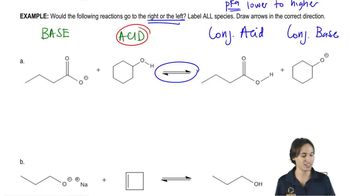
Determining Acid/Base Equilibrium

Conjugate Acids and Bases

A conjugate acid is formed when a base gains a proton (H+), while a conjugate base is what remains after an acid donates a proton. The strength of an acid is inversely related to the strength of its conjugate base; a strong acid has a weak conjugate base. Recognizing these relationships is crucial for determining which side of a reaction is favored based on pKa values.
Recommended video:
Guided course
02:11
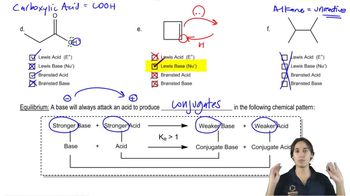
Equilibrium constant and conjugates.

Le Chatelier's Principle

Le Chatelier's Principle states that if a dynamic equilibrium is disturbed by changing the conditions, the system shifts to counteract the change and restore equilibrium. In the context of acid-base reactions, this principle helps predict how changes in concentration, pressure, or temperature can affect the position of equilibrium, guiding the analysis of which side is favored based on pKa values.
Recommended video:
Guided course
04:12
The Electron Configuration