Ch. 4 - Acids and Bases: Electron Flow
Mullins - Organic Chemistry: A Learner Centered Approach 1st Edition
Mullins1st EditionOrganic Chemistry: A Learner Centered ApproachISBN: 9780137566471Not the one you use?Change textbook
Chapter 3, Problem 69

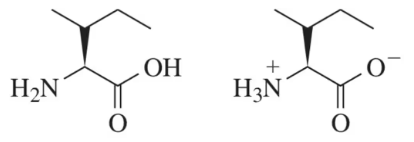
Amino acids exist predominantly in one of the following forms. Which is it? Explain your answer.

Verified step by step guidance
1
Amino acids are amphoteric molecules, meaning they can act as both acids and bases. This property arises due to the presence of an amino group (-NH2) and a carboxylic acid group (-COOH) in their structure.
In aqueous solutions, amino acids predominantly exist in their zwitterionic form. A zwitterion is a molecule that has both positive and negative charges but is overall electrically neutral.
The zwitterionic form occurs because the amino group (-NH2) is protonated to form -NH3⁺, and the carboxylic acid group (-COOH) is deprotonated to form -COO⁻. This happens at a pH close to the isoelectric point of the amino acid.
The structure on the right in the image represents the zwitterionic form of the amino acid, where the amino group is positively charged (H3N⁺) and the carboxyl group is negatively charged (COO⁻). This is the predominant form of amino acids in physiological conditions (around pH 7).
The structure on the left represents the non-ionized form of the amino acid, which is less common in aqueous solutions. It is typically observed in non-polar solvents or under specific conditions where the pH is far from the isoelectric point.

Verified video answer for a similar problem:

This video solution was recommended by our tutors as helpful for the problem above.
Was this helpful?

Key Concepts

Here are the essential concepts you must grasp in order to answer the question correctly.

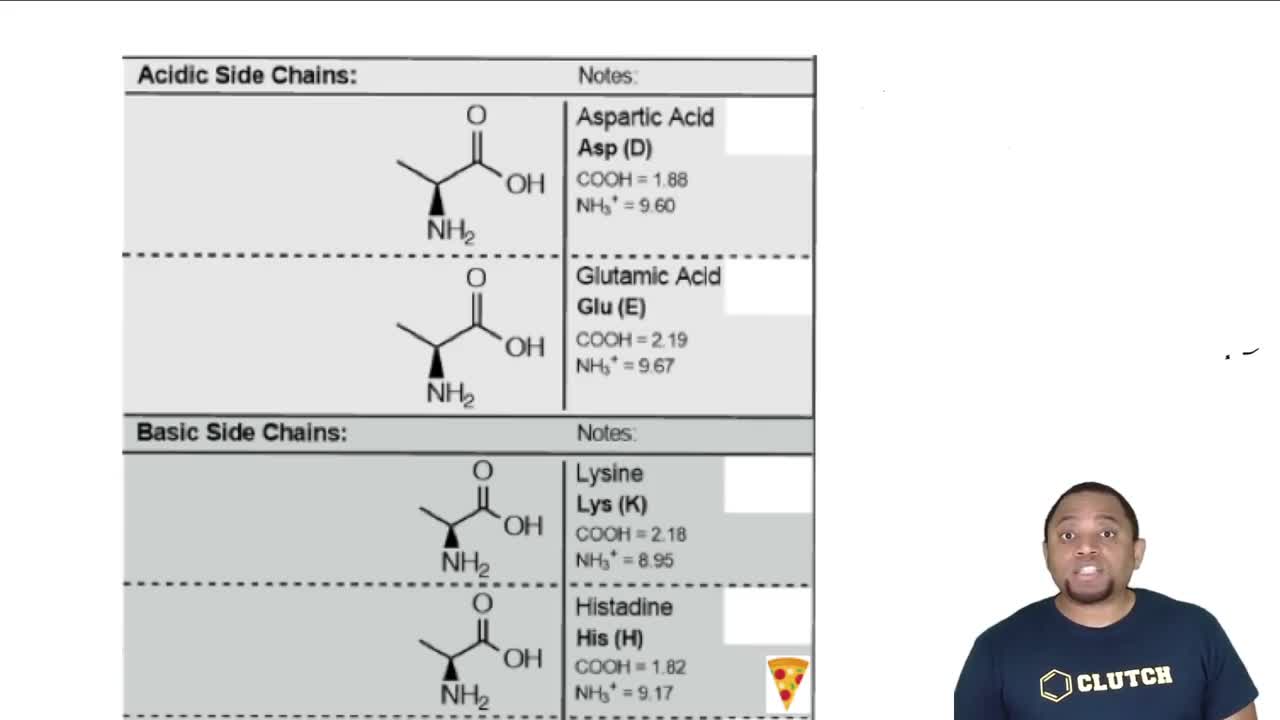
Amino Acid Structure

Amino acids are organic compounds that serve as the building blocks of proteins. Each amino acid has a central carbon atom bonded to an amino group (-NH2), a carboxyl group (-COOH), a hydrogen atom, and a variable side chain (R group) that determines its unique properties. The structure is crucial for understanding how amino acids interact and form proteins.
Recommended video:
Guided course
11:14
Charged Amino Acids

Zwitterion Form

Amino acids predominantly exist in a zwitterionic form at physiological pH, where the amino group is protonated (-NH3+) and the carboxyl group is deprotonated (-COO-). This dual charge allows amino acids to be soluble in water and participate in biochemical reactions, making it essential to recognize this form when discussing their behavior in biological systems.
Recommended video:
Guided course
06:23
Monosaccharides - Forming Cyclic Hemiacetals

pH and Ionization

The ionization state of amino acids is influenced by the pH of the environment. At different pH levels, the amino and carboxyl groups can gain or lose protons, affecting the overall charge of the amino acid. Understanding the relationship between pH and the ionization of amino acids is vital for predicting their behavior in various biological contexts.
Recommended video:
Guided course
04:28
Ionization Potentials