


Ch. 4 - Acids and Bases: Electron Flow
Mullins - Organic Chemistry: A Learner Centered Approach 1st Edition
Mullins1st EditionOrganic Chemistry: A Learner Centered ApproachISBN: 9780137566471Not the one you use?Change textbook
Chapter 3, Problem 78

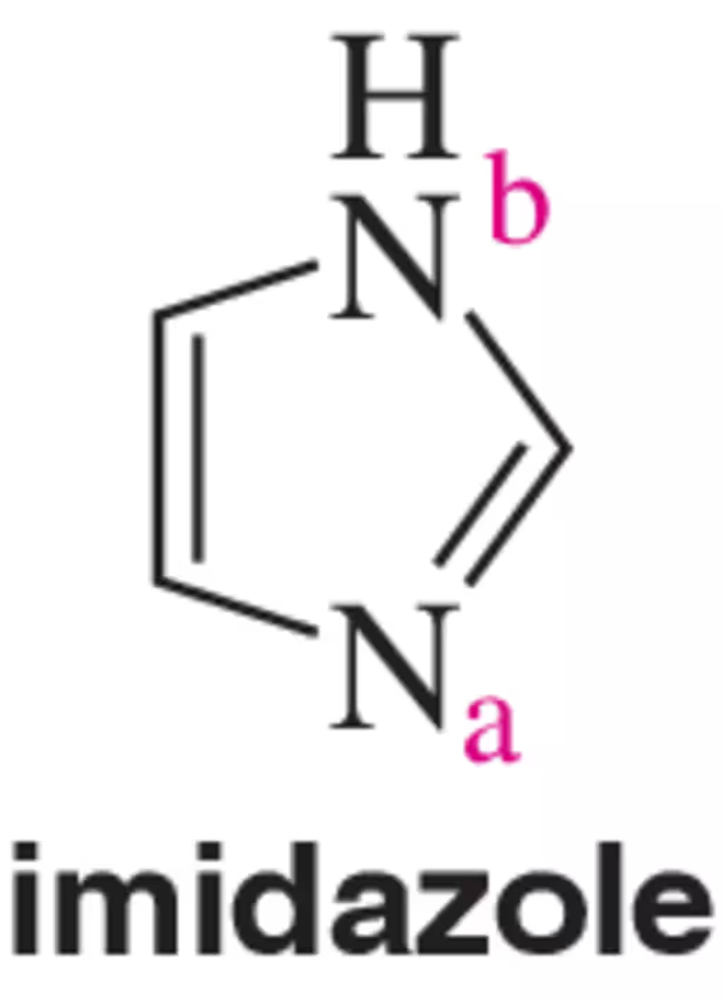
Imidazole has two potentially basic sites (a and b). Of the two, where would you expect a proton to add preferentially?
Chemical structure of imidazole with labeled nitrogen atoms a and b, highlighting potential basic sites for proton addition.

Verified step by step guidance
1
Identify the structure of imidazole, which is a five-membered aromatic heterocyclic compound containing two nitrogen atoms. Label the two nitrogen atoms as 'a' (pyrrole-like nitrogen) and 'b' (pyridine-like nitrogen).
Understand the difference between the two nitrogen atoms: The 'a' nitrogen is part of a double bond and has a lone pair of electrons that is delocalized into the aromatic ring, making it less available for protonation. The 'b' nitrogen has a lone pair of electrons that is not involved in the aromatic system, making it more available for protonation.
Recall the concept of basicity: A site is more basic if it has a lone pair of electrons that is readily available to accept a proton. Since the lone pair on the 'b' nitrogen is not delocalized, it is more basic than the 'a' nitrogen.
Consider the stability of the resulting conjugate acid: Protonation at the 'b' nitrogen leads to a positively charged species that retains aromaticity, whereas protonation at the 'a' nitrogen disrupts the aromaticity of the ring, making it less favorable.
Conclude that the proton will preferentially add to the 'b' nitrogen (pyridine-like nitrogen) because it is more basic and results in a more stable conjugate acid while preserving the aromaticity of the imidazole ring.

Verified video answer for a similar problem:

This video solution was recommended by our tutors as helpful for the problem above.
Video duration:
5m
Was this helpful?

Key Concepts

Here are the essential concepts you must grasp in order to answer the question correctly.

Basicity of Imidazole

Imidazole is a five-membered heterocyclic compound containing two nitrogen atoms. Its basicity is influenced by the electron density on the nitrogen atoms, which can accept protons. The basicity of each nitrogen site is determined by factors such as resonance stabilization and the surrounding electronic environment.
Recommended video:
Guided course
06:21
Understanding the difference between basicity and nucleophilicity.

Protonation Sites

In imidazole, the two nitrogen atoms (labeled a and b) have different electronic properties. Protonation at site a typically leads to a more stable cation due to resonance, as the positive charge can be delocalized over the ring. Understanding the stability of the resulting protonated species is crucial for predicting where protonation will occur preferentially.
Recommended video:
Guided course
04:58
Bond sites, hybridization, and intermediate orbitals

Resonance and Stability

Resonance refers to the delocalization of electrons across multiple structures, which can stabilize charged species. In the case of imidazole, protonation at one nitrogen may allow for greater resonance stabilization compared to the other. This concept is essential for determining the preferred site of protonation, as more stable cations are favored in chemical reactions.
Recommended video:
Guided course
03:43
The radical stability trend.