Ch. 4 - Acids and Bases: Electron Flow
Mullins - Organic Chemistry: A Learner Centered Approach 1st Edition
Mullins1st EditionOrganic Chemistry: A Learner Centered ApproachISBN: 9780137566471Not the one you use?Change textbook
Chapter 3, Problem 79d

In addition to radicals, anions, and cations, a fourth class of reactive intermediates is carbenes. A neutral species, the simplest carbene has a molecular formula of CH2.
(d) Carbenes are also Lewis bases. Based on your answers to (a) and (b), explain this observation.

Verified step by step guidance
1
Carbenes are neutral species with a divalent carbon atom. The carbon atom in a carbene has two bonds and two non-bonding electrons, resulting in a total of six valence electrons, which makes it electron-deficient.
The structure of a carbene, as shown in the image, includes a lone pair of electrons on the carbon atom. This lone pair can act as an electron donor, which is a characteristic of Lewis bases.
Recall that Lewis bases are defined as species that can donate a pair of electrons to form a covalent bond. The lone pair on the carbene's carbon atom fulfills this criterion, allowing carbenes to act as Lewis bases.
In addition to being electron-deficient, carbenes can also exhibit nucleophilic behavior due to the availability of the lone pair of electrons. This dual nature (electron-deficient yet nucleophilic) is a unique feature of carbenes.
Based on the answers to parts (a) and (b), the observation that carbenes are Lewis bases can be explained by their ability to donate the lone pair of electrons on the carbon atom, despite their overall electron-deficient nature.

Verified video answer for a similar problem:

This video solution was recommended by our tutors as helpful for the problem above.
Video duration:
2m
Was this helpful?

Key Concepts

Here are the essential concepts you must grasp in order to answer the question correctly.

Carbenes

Carbenes are neutral reactive intermediates characterized by a carbon atom with only six valence electrons, resulting in a divalent state. The simplest carbene, methylene (CH₂), has two unshared electrons, making it highly reactive. Carbenes can exist in two forms: singlet, where the two electrons are paired, and triplet, where they are unpaired, influencing their reactivity and interactions.
Recommended video:
Guided course
01:48
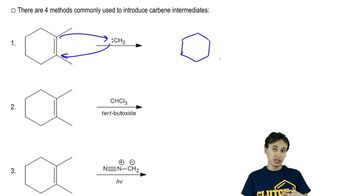
Reaction with a simple carbene.

Lewis Bases

Lewis bases are species that can donate a pair of electrons to form a covalent bond. In the context of carbenes, their two unshared electrons allow them to act as Lewis bases, enabling them to react with electrophiles. This property is crucial for understanding their role in various organic reactions, where they can stabilize positive charges or participate in bond formation.
Recommended video:
Guided course
02:49
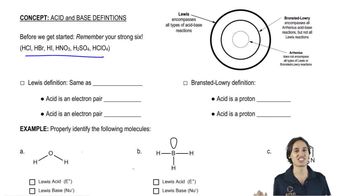
The Lewis definition of acids and bases.

Reactivity of Intermediates

Reactive intermediates, such as carbenes, radicals, and ions, play a significant role in organic reactions. Their stability and reactivity depend on their electronic structure and the surrounding environment. Understanding how carbenes interact with other molecules, particularly as Lewis bases, is essential for predicting reaction pathways and mechanisms in organic chemistry.
Recommended video:
Guided course
02:47
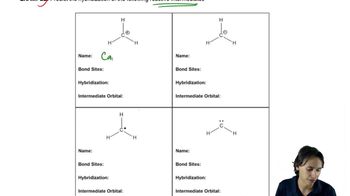
Introduction to the reactive intermediates.