Ch. 3 - Alkanes and Cycloalkanes: Properties and Conformational Analysis
Mullins - Organic Chemistry: A Learner Centered Approach 1st Edition
Mullins1st EditionOrganic Chemistry: A Learner Centered ApproachISBN: 9780137566471Not the one you use?Change textbook
Chapter 2, Problem 3d

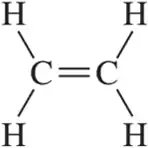
What is the hybridization of carbon in each of the following molecules?
(d) Structural formula of ethene showing carbon atoms double-bonded with hydrogen atoms attached.

Verified step by step guidance
1
Step 1: Understand the concept of hybridization. Hybridization is the mixing of atomic orbitals to form new hybrid orbitals that are suitable for bonding. The type of hybridization depends on the number of electron domains (regions of electron density) around the atom.
Step 2: Identify the molecule in question. Since the problem does not specify the molecule, you would need to examine the structure of the molecule provided in part (d) to determine the number of electron domains around the carbon atom.
Step 3: Count the electron domains around the carbon atom. Electron domains include single bonds, double bonds, triple bonds, and lone pairs. For example, if the carbon is bonded to four atoms with single bonds, it has four electron domains.
Step 4: Determine the hybridization based on the number of electron domains. Use the following guide: (a) 2 electron domains = sp hybridization, (b) 3 electron domains = sp² hybridization, (c) 4 electron domains = sp³ hybridization.
Step 5: Apply the hybridization rule to the carbon atom in the molecule from part (d). Once you count the electron domains, assign the appropriate hybridization (sp, sp², or sp³) to the carbon atom.

Verified video answer for a similar problem:

This video solution was recommended by our tutors as helpful for the problem above.
Video duration:
3m
Was this helpful?

Key Concepts

Here are the essential concepts you must grasp in order to answer the question correctly.

Hybridization

Hybridization is a concept in organic chemistry that describes the mixing of atomic orbitals to form new hybrid orbitals. These hybrid orbitals are used to form covalent bonds in molecules. The type of hybridization (sp, sp2, sp3, etc.) depends on the number of bonds and lone pairs around the central atom, particularly carbon in organic compounds.
Recommended video:
Guided course
10:43
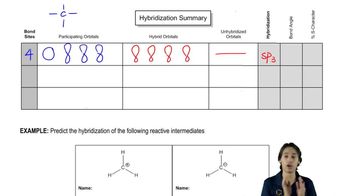
Using bond sites to predict hybridization

Types of Hybridization

There are several types of hybridization that carbon can undergo, including sp3, sp2, and sp. In sp3 hybridization, carbon forms four equivalent bonds with a tetrahedral geometry. In sp2 hybridization, it forms three bonds with a trigonal planar geometry, and in sp hybridization, it forms two bonds with a linear geometry. Understanding these types is crucial for determining the geometry and reactivity of organic molecules.
Recommended video:
Guided course
10:43
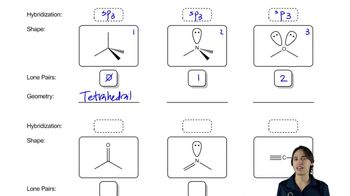
Using bond sites to predict hybridization

Molecular Geometry

Molecular geometry refers to the three-dimensional arrangement of atoms in a molecule. The geometry is influenced by the hybridization of the central atom and the presence of lone pairs. For carbon, the geometry can be tetrahedral, trigonal planar, or linear, depending on its hybridization state, which in turn affects the physical and chemical properties of the molecule.
Recommended video:
Guided course
07:44
Molecular Geometry Explained.