Ch. 3 - Alkanes and Cycloalkanes: Properties and Conformational Analysis
Mullins - Organic Chemistry: A Learner Centered Approach 1st Edition
Mullins1st EditionOrganic Chemistry: A Learner Centered ApproachISBN: 9780137566471Not the one you use?Change textbook
Chapter 2, Problem 6a

How many hydrogens would you expect a 24-carbon compound from each of the following molecular classes to have?
(a) Alkane

Verified step by step guidance
1
Step 1: Recall the general formula for alkanes, which is CnH2n+2. This formula represents the number of hydrogens in a saturated hydrocarbon (alkane) with n carbons.
Step 2: Identify the number of carbons in the given compound. In this case, the compound has 24 carbons, so n = 24.
Step 3: Substitute n = 24 into the general formula for alkanes. The formula becomes H2(24)+2, which simplifies to H50.
Step 4: Understand that this result represents the total number of hydrogens in a 24-carbon alkane, assuming the molecule is fully saturated and contains no double bonds, triple bonds, or rings.
Step 5: Verify the logic by considering the structure of alkanes: each carbon forms four bonds, and in a straight-chain alkane, the hydrogens fill all remaining bonding positions.

Verified video answer for a similar problem:

This video solution was recommended by our tutors as helpful for the problem above.
Was this helpful?

Key Concepts

Here are the essential concepts you must grasp in order to answer the question correctly.

Alkanes

Alkanes are saturated hydrocarbons characterized by single bonds between carbon atoms. The general formula for alkanes is CnH2n+2, where 'n' represents the number of carbon atoms. This formula indicates that for every carbon atom, there are two additional hydrogen atoms, plus two more for the terminal carbons. Therefore, a 24-carbon alkane would have 2(24) + 2 = 50 hydrogen atoms.
Recommended video:
Guided course
02:47
Functionalizing Alkanes

Saturation

Saturation in organic chemistry refers to the presence of single bonds between carbon atoms, meaning that the molecule is fully 'saturated' with hydrogen atoms. Saturated compounds, like alkanes, do not contain double or triple bonds, which would reduce the number of hydrogen atoms. Understanding saturation is crucial for predicting the hydrogen count in hydrocarbons based on their structure.
Recommended video:
Guided course
01:02
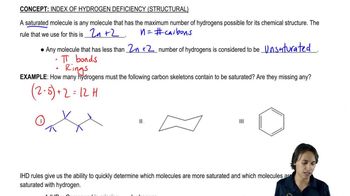
Is the following molecule saturated?

Molecular Formula

A molecular formula provides a concise representation of the number and types of atoms in a compound. For alkanes, the molecular formula reflects the relationship between carbon and hydrogen atoms, allowing for quick calculations of hydrogen counts based on the number of carbon atoms. This concept is essential for determining the expected number of hydrogens in various molecular classes.
Recommended video:
Guided course
02:17
How to use IHD with molecular formula.