
Ch. 3 - Alkanes and Cycloalkanes: Properties and Conformational Analysis
Mullins - Organic Chemistry: A Learner Centered Approach 1st Edition
Mullins1st EditionOrganic Chemistry: A Learner Centered ApproachISBN: 9780137566471Not the one you use?Change textbook
Chapter 2, Problem 20

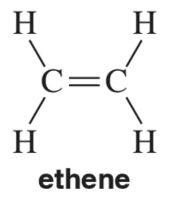
In Chapter 8, we study the chemistry of alkenes, like ethene. In contrast to ethane, there is no free rotation around the C = C double bond of ethene. Explain this in the context of the molecular orbital picture of ethene.

Verified step by step guidance
1
Step 1: Begin by understanding the structure of ethene (C2H4). Ethene contains a carbon-carbon double bond (C=C), which consists of one sigma (σ) bond and one pi (π) bond. The sigma bond is formed by the head-on overlap of sp2 hybrid orbitals, while the pi bond is formed by the side-by-side overlap of unhybridized p orbitals.
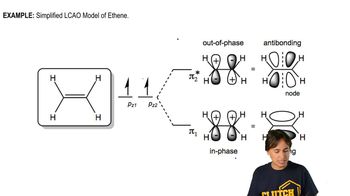
Step 2: In the molecular orbital picture, the pi bond is created by the overlap of the p orbitals from each carbon atom. These p orbitals are oriented perpendicular to the plane of the molecule, and their overlap results in a region of electron density above and below the plane of the molecule.
Step 3: The presence of the pi bond restricts rotation around the C=C double bond. If rotation were to occur, the p orbitals would no longer overlap effectively, breaking the pi bond and destabilizing the molecule. This is why free rotation is not possible around the double bond.
Step 4: Contrast this with a single bond, such as the C-C bond in ethane, which consists only of a sigma bond. Sigma bonds allow free rotation because the electron density is cylindrically symmetrical around the bond axis, meaning rotation does not disrupt the bonding interaction.
Step 5: Conclude by emphasizing that the lack of free rotation around the C=C double bond in ethene is a direct consequence of the molecular orbital arrangement, specifically the side-by-side overlap of p orbitals forming the pi bond.

Verified video answer for a similar problem:

This video solution was recommended by our tutors as helpful for the problem above.
Was this helpful?

Key Concepts

Here are the essential concepts you must grasp in order to answer the question correctly.

Molecular Orbital Theory

Molecular Orbital Theory describes how atomic orbitals combine to form molecular orbitals, which can be occupied by electrons. In ethene, the overlap of p orbitals from each carbon atom forms a pi bond in addition to the sigma bond created by the overlap of their sp2 hybrid orbitals. This pi bond is crucial for understanding the restricted rotation around the double bond.
Recommended video:
Guided course
08:41
Review of Molecular Orbitals

Double Bond Characteristics

A double bond consists of one sigma bond and one pi bond. The sigma bond allows for free rotation, but the pi bond, formed by the side-to-side overlap of p orbitals, creates a planar structure that restricts rotation. This rigidity is a key feature of alkenes like ethene, leading to distinct geometric isomers.
Recommended video:
Guided course
06:00
Single bonds, double bonds, and triple bonds.

Planarity and Hybridization

In ethene, each carbon atom is sp2 hybridized, resulting in a trigonal planar geometry with bond angles of approximately 120 degrees. This planarity is essential for the effective overlap of p orbitals that form the pi bond. The spatial arrangement of the atoms and the presence of the pi bond together prevent rotation around the C=C double bond.
Recommended video:
Guided course
10:43
Using bond sites to predict hybridization