Ionic compounds like sodium acetate have a high melting point. Despite this, they are highly soluble in water. Why?
Ch. 3 - Alkanes and Cycloalkanes: Properties and Conformational Analysis

Mullins1st EditionOrganic Chemistry: A Learner Centered ApproachISBN: 9780137566471Not the one you use?Change textbook
All textbooks
Mullins 1st Edition
Ch. 3 - Alkanes and Cycloalkanes: Properties and Conformational Analysis
Problem 75b
Mullins 1st Edition
Ch. 3 - Alkanes and Cycloalkanes: Properties and Conformational Analysis
Problem 75bChapter 2, Problem 75b
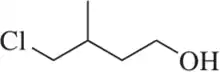
Identify the functional groups in each of the following molecules. [The number of functional groups has been given to assist you.]
(b) [Two]

Verified step by step guidance1
Step 1: Begin by understanding what functional groups are. Functional groups are specific groups of atoms within molecules that are responsible for the characteristic chemical reactions of those molecules. Examples include hydroxyl (-OH), carbonyl (C=O), carboxyl (-COOH), amino (-NH2), and others.
Step 2: Examine the molecular structure provided in the problem. Look for distinct regions in the molecule where specific atoms or groups of atoms are arranged in a way that matches known functional groups.
Step 3: Identify the first functional group by locating a specific arrangement of atoms that corresponds to a known functional group. For example, if you see a carbon atom double-bonded to an oxygen atom (C=O), this is a carbonyl group.
Step 4: Identify the second functional group by continuing to analyze the molecular structure. Look for another distinct arrangement of atoms that matches a different functional group. For instance, if you see a hydroxyl group (-OH) attached to a carbon atom, this is an alcohol functional group.
Step 5: Confirm your findings by cross-referencing the identified functional groups with the molecular structure to ensure there are exactly two functional groups present, as stated in the problem.

Verified video answer for a similar problem:
This video solution was recommended by our tutors as helpful for the problem above.
Video duration:
11mWas this helpful?
Key Concepts
Here are the essential concepts you must grasp in order to answer the question correctly.
Functional Groups
Functional groups are specific groups of atoms within molecules that are responsible for the characteristic chemical reactions of those molecules. They determine the properties and reactivity of organic compounds. Common functional groups include hydroxyl (-OH), carboxyl (-COOH), and amine (-NH2), each imparting distinct behaviors to the molecules they are part of.
Recommended video:
Guided course
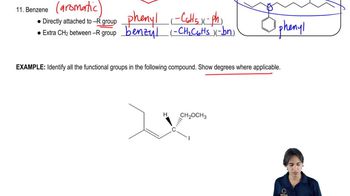
Identifying Functional Groups
Molecular Structure
Molecular structure refers to the arrangement of atoms within a molecule, including the types of bonds and the spatial orientation of the atoms. Understanding molecular structure is crucial for identifying functional groups, as these groups are defined by their specific arrangements and connections to the rest of the molecule. Visualization tools like Lewis structures or 3D models can aid in this understanding.
Recommended video:
Guided course
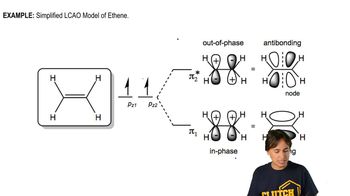
Review of Molecular Orbitals
Nomenclature
Nomenclature in organic chemistry is the system of naming organic compounds based on their structure and functional groups. The International Union of Pure and Applied Chemistry (IUPAC) provides rules for naming, which helps in identifying functional groups within a molecule. Familiarity with nomenclature allows chemists to communicate effectively about the compounds and their properties.
Recommended video:
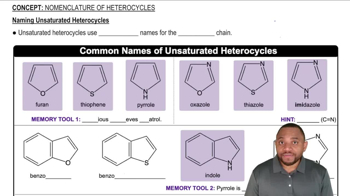
Nomenclature of Heterocycles Concept 2
Related Practice
Textbook Question
1
views
Textbook Question
Identify the functional groups in each of the following molecules. [The number of functional groups has been given to assist you.]
(d) [Two]
1
views
Textbook Question
Despite methylcyclohexane (98.2 amu) having a higher molecular weight than toluene (92.1 amu), toluene melts at a higher temperature. Why? [Think about how the molecules can interact with each other based on their shape.]
1
views
Textbook Question
Identify the functional groups in each of the following molecules. [The number of functional groups has been given to assist you.]
(a) [Three]
1
views
Textbook Question
Identify the functional groups in each of the following molecules. [The number of functional groups has been given to assist you.]
(c) [Three]
5
views