Ch. 3 - Alkanes and Cycloalkanes: Properties and Conformational Analysis
Mullins - Organic Chemistry: A Learner Centered Approach 1st Edition
Mullins1st EditionOrganic Chemistry: A Learner Centered ApproachISBN: 9780137566471Not the one you use?Change textbook
Chapter 2, Problem 75c

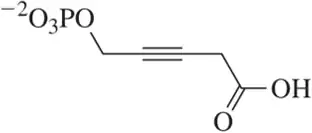
Identify the functional groups in each of the following molecules. [The number of functional groups has been given to assist you.]
(c) [Three]
Chemical structure depicting a molecule with three functional groups, including a phosphate and hydroxyl group.

Verified step by step guidance
1
Step 1: Begin by analyzing the molecular structure provided. Look for characteristic features such as double bonds, hydroxyl groups (-OH), carbonyl groups (C=O), amines (-NH2), or other common functional groups.
Step 2: Identify the first functional group by locating regions in the molecule that match known patterns. For example, a hydroxyl group (-OH) is typically attached to a carbon atom, while a carbonyl group (C=O) is part of aldehydes, ketones, or carboxylic acids.
Step 3: Continue scanning the molecule systematically to identify the second functional group. Pay attention to any heteroatoms (e.g., oxygen, nitrogen, sulfur) or specific bonding arrangements that indicate functional groups such as ethers (R-O-R) or esters (R-COO-R).
Step 4: Locate the third functional group by examining the remaining parts of the molecule. Consider less common functional groups such as halides (R-X), nitriles (-C≡N), or aromatic rings, depending on the structure provided.
Step 5: Confirm the presence of all three functional groups by cross-referencing their locations and ensuring they match the expected chemical properties and bonding patterns. This step ensures accuracy in identifying the functional groups.

Verified video answer for a similar problem:

This video solution was recommended by our tutors as helpful for the problem above.
Video duration:
3m
Was this helpful?

Key Concepts

Here are the essential concepts you must grasp in order to answer the question correctly.

Functional Groups

Functional groups are specific groups of atoms within molecules that are responsible for the characteristic chemical reactions of those molecules. They determine the properties and reactivity of organic compounds. Common functional groups include hydroxyl (-OH), carboxyl (-COOH), and amino (-NH2), each imparting distinct behaviors to the molecules they are part of.
Recommended video:
Guided course
02:36
Identifying Functional Groups

Molecular Structure

Molecular structure refers to the arrangement of atoms within a molecule, including the types of bonds (single, double, or triple) and the spatial orientation of the atoms. Understanding molecular structure is crucial for identifying functional groups, as the presence and connectivity of atoms dictate the functional characteristics of the compound.
Recommended video:
Guided course
08:41
Review of Molecular Orbitals

Nomenclature

Nomenclature in organic chemistry is the system of naming organic compounds based on their structure and functional groups. The International Union of Pure and Applied Chemistry (IUPAC) provides rules for naming, which helps in identifying functional groups and understanding the relationships between different compounds. Familiarity with nomenclature is essential for accurately identifying and communicating about functional groups in various molecules.
Recommended video:
4:02
Nomenclature of Heterocycles Concept 2