Ch. 27 - Carbohydrates, Nucleic Acids, and Lipids
Mullins - Organic Chemistry: A Learner Centered Approach 1st Edition
Mullins1st EditionOrganic Chemistry: A Learner Centered ApproachISBN: 9780137566471Not the one you use?Change textbook
Chapter 26, Problem 62a

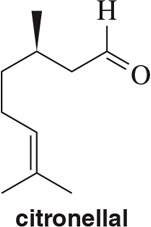
Identify the isoprene units in the terpenes shown. In cross-linked or ring-containing terpenes, linkages can be formed between more than just C1 and C4 of isoprene.
(a) Chemical structure of citronellal, highlighting isoprene units and functional groups.

Verified step by step guidance
1
Step 1: Recall the structure of an isoprene unit. Isoprene is a 5-carbon molecule with the formula C₅H₈, consisting of two double bonds. Its structure can be represented as CH₂=C(CH₃)-CH=CH₂.
Step 2: Understand the concept of terpenes. Terpenes are composed of repeating isoprene units, which are joined together in specific patterns. The connection between isoprene units can occur at various positions, not just C₁ and C₄.
Step 3: Examine the structure of the given terpene. Look for repeating patterns of 5-carbon units that resemble the isoprene structure. Pay attention to any cross-linking or ring formations that may alter the typical linear arrangement.
Step 4: Identify the isoprene units within the terpene structure. Break down the molecule into segments of 5-carbon units and determine how they are connected. Highlight any deviations from the standard C₁-C₄ linkage.
Step 5: Verify your identification by ensuring that each segment matches the molecular formula and structural characteristics of an isoprene unit. Consider how the linkages or rings affect the overall structure of the terpene.

Verified video answer for a similar problem:

This video solution was recommended by our tutors as helpful for the problem above.
Video duration:
3m
Was this helpful?

Key Concepts

Here are the essential concepts you must grasp in order to answer the question correctly.

Isoprene Structure

Isoprene is a five-carbon diene (C₅H₈) with the structure CH₂=C(CH₃)-CH=CH₂. It serves as the fundamental building block for terpenes, which are organic compounds produced by various plants. Understanding the isoprene structure is crucial for identifying how these units combine to form larger, more complex molecules in terpenes.
Recommended video:
Guided course
03:04
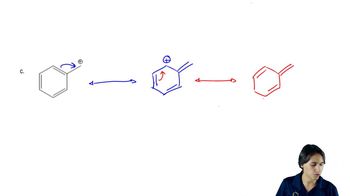
Drawing Resonance Structures

Terpene Classification

Terpenes are classified based on the number of isoprene units they contain. Monoterpenes consist of two isoprene units, sesquiterpenes have three, and so on. This classification helps in understanding the diversity of terpenes and their structural variations, including linear and cyclic forms, which are essential for identifying specific terpenes in the question.
Recommended video:
Guided course
07:17
Structural Classification

Cross-Linking in Terpenes

Cross-linking in terpenes refers to the formation of bonds between isoprene units that do not follow the typical C₁ to C₄ linkage. This can lead to the creation of complex structures such as rings or branched chains. Recognizing these alternative linkages is vital for accurately identifying the isoprene units in more intricate terpenes, especially in cyclic or cross-linked forms.
Recommended video:
Guided course
09:51
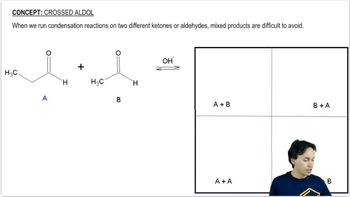
Crossed Aldol