Ch. 27 - Carbohydrates, Nucleic Acids, and Lipids
Mullins - Organic Chemistry: A Learner Centered Approach 1st Edition
Mullins1st EditionOrganic Chemistry: A Learner Centered ApproachISBN: 9780137566471Not the one you use?Change textbook
Chapter 26, Problem 60

Draw a mechanism for the acid-catalyzed, nonenzymatic conversion of DPP to IPP. How do you know your mechanism is correct?
Mechanism of acid-catalyzed conversion of DPP to IPP, showing reactants, catalyst, and products.

Verified step by step guidance
1
Step 1: Identify the reactant (DPP) and product (IPP) structures. DPP contains a phosphate group attached to an isopentenyl chain, while IPP has a double bond in the isopentenyl chain. The reaction is acid-catalyzed, meaning H2SO4 provides protons to facilitate the mechanism.
Step 2: Protonation of the phosphate group occurs first. The acidic environment (H2SO4) donates a proton (H⁺) to one of the oxygen atoms on the phosphate group, increasing its electrophilicity and making it more susceptible to nucleophilic attack.
Step 3: A rearrangement occurs in the isopentenyl chain. The protonated phosphate group facilitates the formation of a carbocation intermediate by breaking the bond between the phosphate group and the isopentenyl chain. This carbocation is stabilized by resonance within the isopentenyl structure.
Step 4: Deprotonation of the carbocation intermediate leads to the formation of the double bond in the isopentenyl chain. A base (likely water or another molecule in the acidic solution) abstracts a proton from the carbocation, resulting in the formation of the double bond.
Step 5: The final product (IPP) is formed, with the double bond in the isopentenyl chain and the phosphate group remaining intact. The mechanism is correct because it follows the principles of acid-catalyzed reactions, including protonation, carbocation formation, and deprotonation steps.

Verified video answer for a similar problem:

This video solution was recommended by our tutors as helpful for the problem above.
Video duration:
12m
Was this helpful?

Key Concepts

Here are the essential concepts you must grasp in order to answer the question correctly.

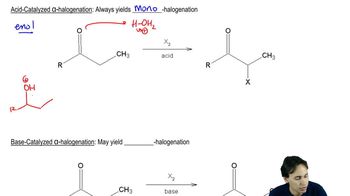
Acid-Catalyzed Reactions

Acid-catalyzed reactions involve the use of an acid to increase the rate of a chemical reaction. In this context, the acid (H2SO4) donates protons (H+) to the reactants, facilitating the formation of intermediates that lead to the desired products. This mechanism often includes protonation steps that stabilize reactive species, making it essential to understand how acids influence reaction pathways.
Recommended video:
Guided course
03:09
Acid Catalyzed

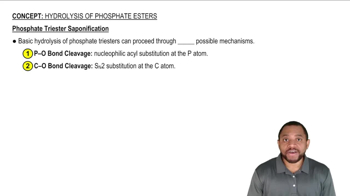
Mechanism of Phosphate Ester Hydrolysis

The conversion of DPP to IPP involves the hydrolysis of phosphate esters, where water plays a crucial role in breaking the P-O bonds. Understanding the mechanism requires knowledge of nucleophilic attack by water on the phosphorus atom, leading to the formation of intermediates and ultimately the products. This process is vital in biochemical pathways and is influenced by the presence of acid, which can enhance the reaction rate.
Recommended video:
0:48
Hydrolysis of Phosphate Esters Concept 2

Reaction Mechanism Validation

To validate a proposed reaction mechanism, one must ensure that it aligns with experimental observations and theoretical principles. This includes checking for the correct stoichiometry, identifying intermediates, and confirming that the energy profile of the reaction is feasible. Additionally, comparing the predicted products with those obtained experimentally is crucial for establishing the accuracy of the mechanism.
Recommended video:
Guided course
02:16
Heck Reaction Mechanism