Ch. 26 - Amino Acids, Proteins, and Peptide Synthesis
Mullins - Organic Chemistry: A Learner Centered Approach 1st Edition
Mullins1st EditionOrganic Chemistry: A Learner Centered ApproachISBN: 9780137566471Not the one you use?Change textbook
Chapter 25, Problem 1b

Give the pKa value of the following compounds.
b. Chemical structure of acetic acid, showing a carbon atom bonded to a hydroxyl group and a carbonyl group.

Verified step by step guidance
1
Identify the functional group(s) present in the compound. The pKa value is influenced by the type of functional group, as different groups have characteristic pKa ranges. For example, carboxylic acids typically have pKa values around 4-5, while alcohols have pKa values around 15-18.
Consider the electronic effects of substituents on the compound. Electron-withdrawing groups (e.g., -NO2, -Cl) can stabilize the conjugate base, lowering the pKa value, while electron-donating groups (e.g., -CH3, -OCH3) can destabilize the conjugate base, raising the pKa value.
Analyze the hybridization of the atom bearing the acidic proton. For example, sp-hybridized carbons (as in alkynes) are more electronegative and result in lower pKa values compared to sp2 (alkenes) or sp3 (alkanes) hybridized carbons.
Account for resonance stabilization of the conjugate base. If the conjugate base can delocalize its negative charge through resonance, the compound will have a lower pKa value. For example, phenols have lower pKa values than alcohols due to resonance stabilization of the phenoxide ion.
Use reference tables or known pKa values of similar compounds to estimate the pKa of the given compound. Compare the structure of the compound to known examples to make an informed prediction.

Verified video answer for a similar problem:

This video solution was recommended by our tutors as helpful for the problem above.
Video duration:
2m
Was this helpful?

Key Concepts

Here are the essential concepts you must grasp in order to answer the question correctly.

pKa Value

The pKa value is a quantitative measure of the acidity of a compound, indicating the strength of an acid in solution. It is defined as the negative logarithm of the acid dissociation constant (Ka). A lower pKa value signifies a stronger acid, as it indicates a greater tendency to donate protons (H+ ions) in an aqueous solution.
Recommended video:
Guided course
07:45
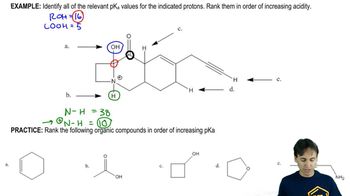
Identifying pKa values

Acid-Base Equilibrium

Acid-base equilibrium refers to the balance between the concentrations of acids and their conjugate bases in a solution. This equilibrium is crucial for understanding how pKa values influence the behavior of compounds in different pH environments. The position of this equilibrium can shift based on the pH of the solution, affecting the protonation state of the compounds.
Recommended video:
Guided course
04:00
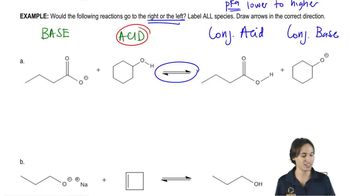
Determining Acid/Base Equilibrium

Functional Groups

Functional groups are specific groups of atoms within molecules that are responsible for the characteristic chemical reactions of those molecules. Different functional groups, such as carboxylic acids, alcohols, and amines, have distinct pKa values, which influence their acidity and reactivity. Understanding these groups is essential for predicting the behavior of compounds in acid-base reactions.
Recommended video:
Guided course
02:36
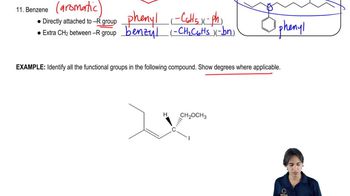
Identifying Functional Groups