Ch. 26 - Amino Acids, Proteins, and Peptide Synthesis
Mullins - Organic Chemistry: A Learner Centered Approach 1st Edition
Mullins1st EditionOrganic Chemistry: A Learner Centered ApproachISBN: 9780137566471Not the one you use?Change textbook
Chapter 25, Problem 2

Calculate the equilibrium constant for the reaction of ethylamine and propanoic acid. Which side is favored?
Chemical reaction diagram showing ethylamine and propanoic acid forming their conjugate acid and base.

Verified step by step guidance
1
Identify the chemical reaction between ethylamine (C2H5NH2) and propanoic acid (C2H5COOH). The reaction is a typical acid-base reaction where ethylamine acts as a base and propanoic acid acts as an acid.
Write the balanced chemical equation for the reaction: C2H5NH2 + C2H5COOH ⇌ C2H5NH3+ + C2H5COO−.
Determine the expression for the equilibrium constant (K_eq) for the reaction. The equilibrium constant expression is given by: K_eq = ([C2H5NH3+][C2H5COO−]) / ([C2H5NH2][C2H5COOH]).
Use the known pKa values of the acid (propanoic acid) and the conjugate acid (ethylammonium ion) to calculate the equilibrium constant. The relationship between pKa and K_eq can be used: K_eq = 10^(pKa(base) - pKa(acid)).
Analyze the calculated K_eq value to determine which side of the reaction is favored. If K_eq > 1, the products are favored; if K_eq < 1, the reactants are favored.

Verified video answer for a similar problem:

This video solution was recommended by our tutors as helpful for the problem above.
Was this helpful?

Key Concepts

Here are the essential concepts you must grasp in order to answer the question correctly.

Equilibrium Constant (K)

The equilibrium constant (K) is a numerical value that expresses the ratio of the concentrations of products to reactants at equilibrium for a given chemical reaction. It is calculated using the formula K = [products]/[reactants], where the concentrations are raised to the power of their coefficients in the balanced equation. A K value greater than 1 indicates that products are favored, while a value less than 1 suggests that reactants are favored.
Recommended video:
Guided course
02:19
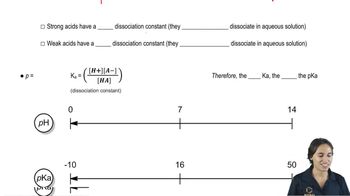
The relationship between equilibrium constant and pKa.

Acid-Base Reaction

An acid-base reaction involves the transfer of protons (H+) between an acid and a base. In this context, propanoic acid acts as the acid, donating a proton, while ethylamine acts as the base, accepting the proton. Understanding the strength of the acid and base involved is crucial, as stronger acids and bases will influence the position of equilibrium and the value of the equilibrium constant.
Recommended video:
Guided course
02:49
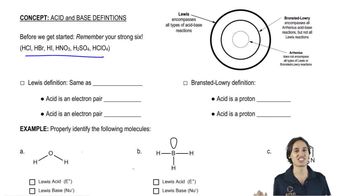
The Lewis definition of acids and bases.

Le Chatelier's Principle

Le Chatelier's Principle states that if a system at equilibrium is disturbed by a change in concentration, temperature, or pressure, the system will adjust to counteract the disturbance and restore a new equilibrium. This principle helps predict how changes in conditions will affect the position of equilibrium, allowing us to determine which side of the reaction is favored based on the equilibrium constant and the nature of the reactants and products.
Recommended video:
Guided course
04:12
The Electron Configuration