Ch. 24 - Benzene II: Reactions Influenced by the Aromatic Ring
Mullins - Organic Chemistry: A Learner Centered Approach 1st Edition
Mullins1st EditionOrganic Chemistry: A Learner Centered ApproachISBN: 9780137566471Not the one you use?Change textbook
Chapter 23, Problem 60

Sulpiride is an antipsychotic. Provide the reagents (a) and (b) used to complete the synthesis.
Chemical reaction diagram illustrating the synthesis of Sulpiride, showing reagents (a) and (b) with structural formulas.

Verified step by step guidance
1
Step 1: Analyze the first transformation. The starting material is a sulfonamide with a hydroxyl group. The product has an additional carbonyl group adjacent to the hydroxyl group, suggesting an acylation reaction. Consider using an acyl chloride or anhydride as reagent (a) to introduce the acyl group.
Step 2: Consider the mechanism for the acylation. The hydroxyl group can act as a nucleophile, attacking the electrophilic carbonyl carbon of the acyl chloride or anhydride, leading to the formation of an ester linkage.
Step 3: Analyze the second transformation. The intermediate product has a carbonyl group and the final product has an additional nitrogen-containing ring structure. This suggests a nucleophilic substitution reaction where the nitrogen atom of the ring structure attacks the carbonyl carbon.
Step 4: Consider the mechanism for the nucleophilic substitution. The nitrogen atom in the ring structure can act as a nucleophile, attacking the electrophilic carbonyl carbon, leading to the formation of an amide linkage.
Step 5: Identify reagent (b) as a nitrogen-containing compound, such as a cyclic amine, that can undergo nucleophilic attack on the carbonyl group to form the final product, Sulpiride.

Verified video answer for a similar problem:

This video solution was recommended by our tutors as helpful for the problem above.
Video duration:
13m
Was this helpful?

Key Concepts

Here are the essential concepts you must grasp in order to answer the question correctly.

Sulfonamide Chemistry

Sulfonamides are a class of organic compounds characterized by the presence of a sulfonyl group attached to an amine. They are crucial in pharmaceuticals due to their antibacterial properties. Understanding the reactivity and synthesis of sulfonamides is essential for designing drugs like Sulpiride, which involves the transformation of sulfonamide precursors.
Recommended video:
Guided course
00:28
Introduction to General Chemistry Review

Amide Bond Formation

Amide bond formation is a fundamental reaction in organic chemistry, often used in the synthesis of pharmaceuticals. It involves the reaction between a carboxylic acid derivative and an amine, forming an amide linkage. This process is key in the synthesis of Sulpiride, where amide bonds are formed to build the drug's complex structure.
Recommended video:
Guided course
01:33
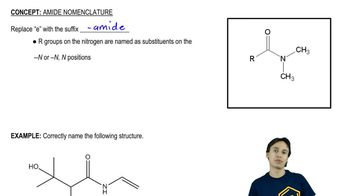
Amide Nomenclature

Reagent Selection in Organic Synthesis

Choosing appropriate reagents is critical in organic synthesis to achieve desired transformations efficiently. Reagents are selected based on their ability to facilitate specific chemical reactions, such as oxidation, reduction, or functional group interconversion. In the synthesis of Sulpiride, selecting reagents (a) and (b) is crucial for progressing through the synthetic pathway to achieve the final product.
Recommended video:
1:16
Synthesis of Amino Acids: Strecker Synthesis Example 1