Ch. 24 - Benzene II: Reactions Influenced by the Aromatic Ring
Mullins - Organic Chemistry: A Learner Centered Approach 1st Edition
Mullins1st EditionOrganic Chemistry: A Learner Centered ApproachISBN: 9780137566471Not the one you use?Change textbook
Chapter 23, Problem 3

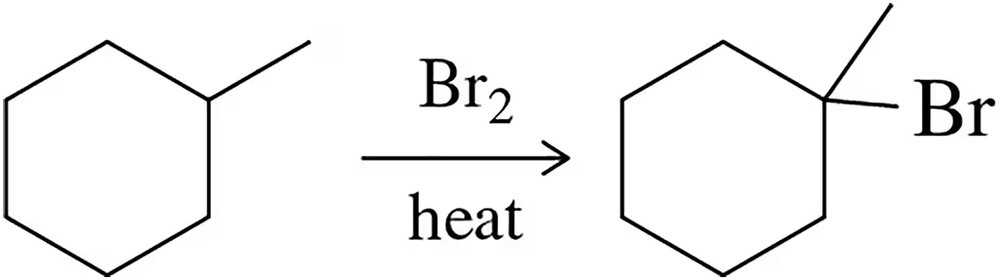
Provide an arrow-pushing mechanism for the following alkane bromination. [Don't forget to use fishhook arrows to represent the movement of single electrons.]
Alkane bromination reaction showing cyclohexane with Br2 and heat, forming bromocyclohexane.

Verified step by step guidance
1
Step 1: Initiation - Begin by homolytic cleavage of the bromine molecule (Br₂) to form two bromine radicals. Use fishhook arrows to show the movement of single electrons from the Br-Br bond to each bromine atom, resulting in two Br• radicals.
Step 2: Propagation - The bromine radical (Br•) abstracts a hydrogen atom from the alkane, forming a hydrogen bromide (HBr) and an alkyl radical. Use a fishhook arrow to show the movement of a single electron from the Br• to the hydrogen atom, and another fishhook arrow to show the movement of the single electron from the C-H bond to the carbon atom, forming the alkyl radical.
Step 3: Propagation - The alkyl radical reacts with another bromine molecule (Br₂), forming the brominated alkane and regenerating a bromine radical. Use fishhook arrows to show the movement of single electrons from the alkyl radical and the Br-Br bond to form the new C-Br bond and regenerate Br•.
Step 4: Termination - Two radicals combine to form a stable molecule, terminating the chain reaction. This can occur between two bromine radicals, two alkyl radicals, or an alkyl radical and a bromine radical. Use fishhook arrows to show the movement of single electrons from each radical to form a covalent bond.
Step 5: Review the mechanism - Ensure that all steps are balanced in terms of electron movement and that the overall reaction results in the bromination of the alkane. Check that all fishhook arrows correctly represent the movement of single electrons throughout the mechanism.

Verified video answer for a similar problem:

This video solution was recommended by our tutors as helpful for the problem above.
Video duration:
5m
Was this helpful?

Key Concepts

Here are the essential concepts you must grasp in order to answer the question correctly.

Radical Halogenation

Radical halogenation is a reaction where alkanes react with halogens, such as bromine, under UV light or heat to form haloalkanes. The process involves the formation of radicals, which are highly reactive species with unpaired electrons, and proceeds through initiation, propagation, and termination steps.
Recommended video:
Guided course
12:11
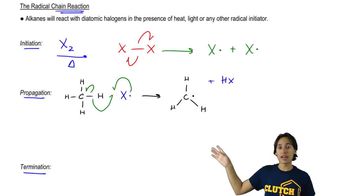
Radical Chain Reaction Mechanism.

Fishhook Arrows

Fishhook arrows are used in organic chemistry to depict the movement of single electrons during radical reactions. Unlike regular arrows, which show the movement of electron pairs, fishhook arrows indicate the transfer of one electron, essential for illustrating radical mechanisms like alkane bromination.
Recommended video:
Guided course
10:22
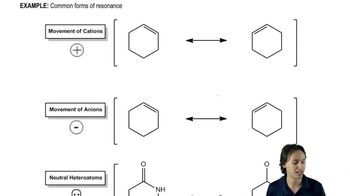
Common ways to move arrows in resonance.

Mechanism Steps: Initiation, Propagation, Termination

The mechanism of radical reactions includes three main steps: initiation, where radicals are generated; propagation, where radicals react with stable molecules to form new radicals; and termination, where radicals combine to form stable products. Understanding these steps is crucial for mapping out the arrow-pushing mechanism in alkane bromination.
Recommended video:
3:05
Polyurethane Mechanism Example 1