Ch. 23 - Benzene I: Aromatic Stability and Substitution Reactions
Mullins - Organic Chemistry: A Learner Centered Approach 1st Edition
Mullins1st EditionOrganic Chemistry: A Learner Centered ApproachISBN: 9780137566471Not the one you use?Change textbook
Chapter 22, Problem 16d

(i) Classify the following molecules as aromatic, nonaromatic, or antiaromatic.
(ii) For the aromatic and antiaromatic molecules, solve for n in Hückel’s/Breslow’s rule. For the other molecules, explain which of the rules of aromaticity is being broken.
(d) Chemical structure of a pentagonal ring with a positive charge, used for classifying aromaticity in molecules.

Verified step by step guidance
1
Identify the molecule structure: The image shows a cyclopentadienyl cation, which is a five-membered ring with two double bonds and a positive charge.
Determine the number of π electrons: Count the π electrons in the molecule. Each double bond contributes two π electrons, so there are 4 π electrons in total.
Apply Hückel's rule: Hückel's rule states that a molecule is aromatic if it has (4n + 2) π electrons, where n is a non-negative integer. Check if the molecule fits this rule.
Evaluate antiaromaticity: If the molecule has 4n π electrons, it is considered antiaromatic. Check if the molecule fits this condition.
Classify the molecule: Based on the number of π electrons and the application of Hückel's rule, classify the molecule as aromatic, nonaromatic, or antiaromatic. In this case, the cyclopentadienyl cation with 4 π electrons is antiaromatic.

Verified video answer for a similar problem:

This video solution was recommended by our tutors as helpful for the problem above.
Was this helpful?

Key Concepts

Here are the essential concepts you must grasp in order to answer the question correctly.

Aromaticity

Aromaticity refers to the special stability and unique properties of cyclic compounds that follow Hückel's rule, which states that a molecule is aromatic if it has (4n + 2) π electrons, where n is a non-negative integer. Aromatic compounds are typically planar, fully conjugated, and exhibit resonance, leading to lower energy and increased stability compared to non-aromatic compounds.
Recommended video:
Guided course
08:19
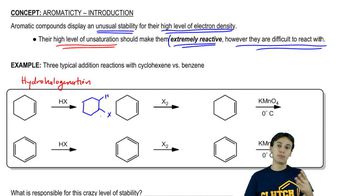
Intro to Aromaticity

Anti-aromaticity

Anti-aromaticity describes compounds that are cyclic, planar, and fully conjugated but contain 4n π electrons, which leads to instability. These compounds are less stable than their non-aromatic counterparts due to the presence of destabilizing interactions among the π electrons, making them highly reactive and less favorable in chemical reactions.
Recommended video:
Guided course
03:19
The Anti-Coplanar Requirement

Hückel's Rule

Hückel's Rule is a criterion used to determine the aromaticity of a compound based on its π electron count. According to this rule, a planar, cyclic molecule is aromatic if it contains (4n + 2) π electrons. Conversely, if it contains 4n π electrons, it is classified as anti-aromatic. This rule is essential for classifying the stability and reactivity of cyclic compounds in organic chemistry.
Recommended video:
Guided course
03:54
The 18 and 16 Electron Rule