
Ch. 23 - Benzene I: Aromatic Stability and Substitution Reactions
Mullins - Organic Chemistry: A Learner Centered Approach 1st Edition
Mullins1st EditionOrganic Chemistry: A Learner Centered ApproachISBN: 9780137566471Not the one you use?Change textbook
Chapter 22, Problem 13

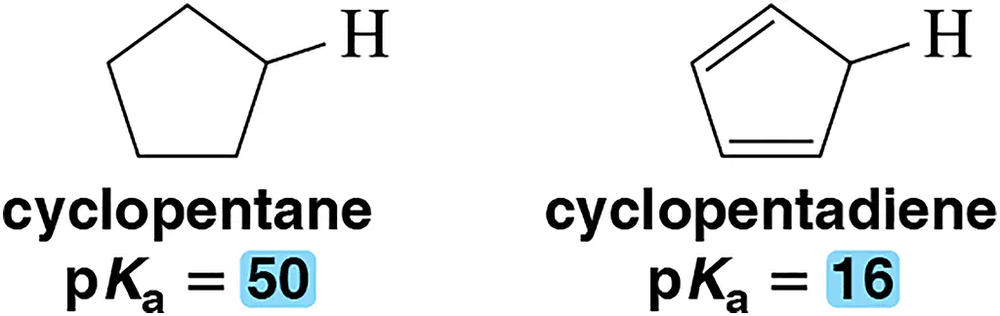
Cyclopentane has pKₐ = 50, whereas cyclopentadiene has pKₐ = 16. Explain this difference.
Structural formulas of cyclopentane and cyclopentadiene with their pKₐ values, 50 and 16, respectively.

Verified step by step guidance
1
Identify the structures of cyclopentane and cyclopentadiene. Cyclopentane is a saturated hydrocarbon with no double bonds, while cyclopentadiene contains two conjugated double bonds.
Understand the concept of pKₐ, which is a measure of the acidity of a compound. A lower pKₐ value indicates a stronger acid.
Consider the stability of the conjugate base formed after deprotonation. Cyclopentadiene, when deprotonated, forms a cyclopentadienyl anion, which is aromatic and highly stabilized by resonance.
Recognize that cyclopentane, when deprotonated, forms a non-aromatic anion with no resonance stabilization, making it a much weaker acid compared to cyclopentadiene.
Conclude that the significant difference in pKₐ values is due to the aromatic stabilization of the cyclopentadienyl anion, which is absent in the cyclopentane anion.

Verified video answer for a similar problem:

This video solution was recommended by our tutors as helpful for the problem above.
Was this helpful?

Key Concepts

Here are the essential concepts you must grasp in order to answer the question correctly.

pKa and Acidity

The pKa value is a measure of the acidity of a compound, indicating how easily a compound donates a proton (H+). A lower pKa value corresponds to a stronger acid, meaning it more readily donates a proton. In this context, cyclopentadiene with a pKa of 16 is a much stronger acid than cyclopentane, which has a pKa of 50, indicating a significant difference in their acidity.
Recommended video:
Guided course
07:45
Identifying pKa values

Aromaticity and Stability

Aromaticity refers to the increased stability of a compound due to the delocalization of electrons in a conjugated pi system. Cyclopentadiene can form an aromatic anion upon losing a proton, as it achieves a stable, aromatic 6 pi-electron system. This stability significantly lowers its pKa compared to cyclopentane, which lacks such stabilization.
Recommended video:
Guided course
08:19
Intro to Aromaticity

Conjugation and Resonance

Conjugation involves the overlap of p-orbitals across adjacent atoms, allowing for electron delocalization. In cyclopentadiene, the presence of conjugated double bonds allows for resonance stabilization of the resulting anion after deprotonation. This resonance stabilization is absent in cyclopentane, contributing to its much higher pKa value.
Recommended video:
Guided course
05:29
Definition of Conjugation