Textbook Question
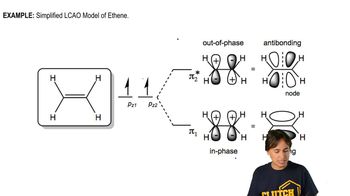
The molecular orbital picture of H2 can be represented by the following diagram. Label σ and σ* on the diagram—that is, which is (a) and which is (b)? Which is lower in energy? Why?
<IMAGE>
1
views

 Mullins 1st EditionCh. 21 - Conjugated Systems I: Stability and Addition ReactionsProblem 16
 Verified step by step guidance
 08:41
08:41
 1:21
1:21 01:34
01:34The molecular orbital picture of H2 can be represented by the following diagram. Label σ and σ* on the diagram—that is, which is (a) and which is (b)? Which is lower in energy? Why?
<IMAGE>
Using the rules described in Section 21.3, draw the molecular orbital picture of hexa-1,3,5-triene. Label the HOMO and LUMO.
Hexa-1,3,5-triene uses six p orbitals, each containing a single electron, to make its three π bonds. How many total molecular orbitals are made by the six p orbitals?
Suppose a molecule is formed by the overlap of 16 atomic orbitals.
(a) How many molecular orbitals will be present?
(b) How many will be bonding?
(c) How many will be antibonding?
The ψ2 molecular orbital for octa-1,3,5,7-tetraene is shown. Draw ψ3.
<IMAGE>
Which of the following would you expect to be a more stable molecular orbital? Why?
<IMAGE>