Ch. 21 - Conjugated Systems I: Stability and Addition Reactions
Mullins - Organic Chemistry: A Learner Centered Approach 1st Edition
Mullins1st EditionOrganic Chemistry: A Learner Centered ApproachISBN: 9780137566471Not the one you use?Change textbook
Chapter 20, Problem 20

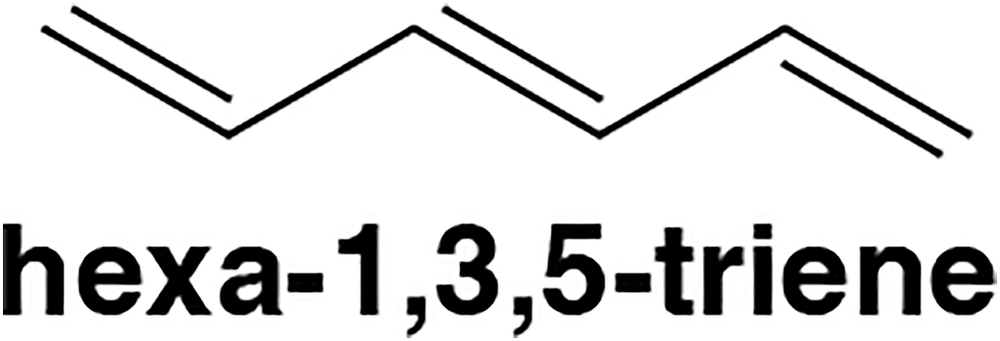
Using the rules described in Section 21.3, draw the molecular orbital picture of hexa-1,3,5-triene. Label the HOMO and LUMO.
Molecular structure of hexa-1,3,5-triene with labeled double bonds and the text "hexa-1,3,5-triene" below.

Verified step by step guidance
1
Step 1: Begin by identifying the structure of hexa-1,3,5-triene. It is a conjugated system with six carbon atoms and alternating double and single bonds. The conjugation allows for delocalization of π-electrons across the molecule.
Step 2: Determine the number of π-electrons in the molecule. Each double bond contributes two π-electrons, so hexa-1,3,5-triene has a total of 6 π-electrons.
Step 3: Construct the molecular orbital diagram for the conjugated system. The six π-electrons will occupy molecular orbitals formed by the overlap of p-orbitals on the six carbon atoms. Label the orbitals as Ψ₁, Ψ₂, Ψ₃, Ψ₄, Ψ₅, and Ψ₆, where Ψ₁ is the lowest energy orbital and Ψ₆ is the highest energy orbital.
Step 4: Fill the molecular orbitals with the 6 π-electrons according to the Aufbau principle, starting with the lowest energy orbital (Ψ₁) and proceeding upward. Each orbital can hold a maximum of two electrons. The highest occupied molecular orbital (HOMO) will be the last orbital filled with electrons, and the lowest unoccupied molecular orbital (LUMO) will be the next orbital above the HOMO.
Step 5: Label the HOMO and LUMO in the molecular orbital diagram. The HOMO is the highest energy orbital that contains electrons, and the LUMO is the lowest energy orbital that does not contain electrons. These labels are critical for understanding the molecule's reactivity and electronic transitions.

Verified video answer for a similar problem:

This video solution was recommended by our tutors as helpful for the problem above.
Video duration:
9m
Was this helpful?

Key Concepts

Here are the essential concepts you must grasp in order to answer the question correctly.

Molecular Orbitals

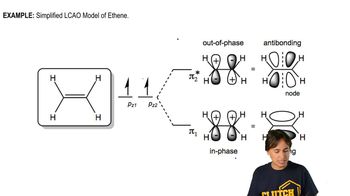
Molecular orbitals (MOs) are formed by the linear combination of atomic orbitals (LCAO) when atoms bond together. In conjugated systems like hexa-1,3,5-triene, MOs can be delocalized over multiple atoms, allowing for the sharing of electrons across the molecule. Understanding how these orbitals are constructed is essential for predicting the electronic properties and reactivity of the compound.
Recommended video:
Guided course
08:41
Review of Molecular Orbitals

HOMO and LUMO

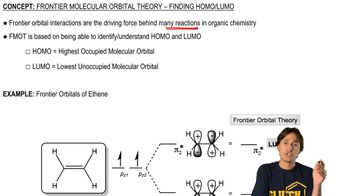
The Highest Occupied Molecular Orbital (HOMO) and the Lowest Unoccupied Molecular Orbital (LUMO) are critical in determining a molecule's reactivity and electronic transitions. The HOMO is the highest energy orbital that contains electrons, while the LUMO is the lowest energy orbital that is empty. The energy gap between these two orbitals influences the molecule's ability to absorb light and participate in chemical reactions.
Recommended video:
Guided course
02:35
HOMO vs. LUMO

Conjugation

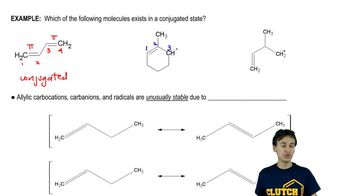
Conjugation refers to the overlap of p-orbitals across adjacent double bonds or lone pairs, leading to a system of alternating single and double bonds. In hexa-1,3,5-triene, this delocalization of π-electrons enhances stability and affects the electronic properties of the molecule. Recognizing the extent of conjugation is vital for accurately drawing the molecular orbital diagram and understanding the compound's behavior.
Recommended video:
Guided course
03:27
Conjugated states