Ch. 20 - Enolates: Carbonyl Addition and Substitution
Mullins - Organic Chemistry: A Learner Centered Approach 1st Edition
Mullins1st EditionOrganic Chemistry: A Learner Centered ApproachISBN: 9780137566471Not the one you use?Change textbook
Chapter 19, Problem 17b

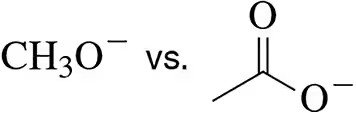
Specify which in each pair is the harder Lewis base. Justify your choice beyond just looking at Table 20.2.
(b) Comparison of two Lewis bases: methoxide ion (CH3O−) on the left and acetate ion (O−) on the right.

Verified step by step guidance
1
Identify the two species in the pair and recall the definition of a Lewis base: a Lewis base is a species that donates a pair of electrons to form a bond with a Lewis acid.
Examine the electronic structure of each species. Consider factors such as the availability of the lone pair of electrons for donation, the electronegativity of the atom holding the lone pair, and the steric hindrance around the donating atom.
Analyze the resonance effects in each species. If the lone pair is delocalized through resonance, it will be less available for donation, making the species a weaker Lewis base.
Consider inductive effects. Electron-withdrawing groups near the donating atom can decrease the electron density on the lone pair, making it less available for donation, while electron-donating groups can increase the electron density, enhancing the Lewis base strength.
Compare the two species based on the above factors and determine which one has a more readily available lone pair for donation, making it the harder Lewis base. Justify your choice with a clear explanation of the electronic and structural factors involved.

Verified video answer for a similar problem:

This video solution was recommended by our tutors as helpful for the problem above.
Video duration:
3m
Was this helpful?

Key Concepts

Here are the essential concepts you must grasp in order to answer the question correctly.

Lewis Bases

A Lewis base is defined as a substance that can donate an electron pair to form a covalent bond. This concept is fundamental in understanding acid-base reactions in organic chemistry, where the strength of a Lewis base is determined by its ability to share electrons. Factors such as electronegativity, steric hindrance, and the presence of electron-donating groups influence a compound's basicity.
Recommended video:
Guided course
02:49
The Lewis definition of acids and bases.

Basicity Trends

Basicity trends in organic chemistry refer to the relative strength of Lewis bases, which can be influenced by the structure and electronic properties of the molecules involved. For example, basicity generally increases with the availability of lone pairs and decreases with the presence of electronegative atoms that can withdraw electron density. Understanding these trends helps in predicting the reactivity of different Lewis bases in chemical reactions.
Recommended video:
Guided course
06:21
Understanding the difference between basicity and nucleophilicity.

Solvation Effects

Solvation effects describe how solvent molecules interact with solute ions or molecules, impacting their reactivity and stability. In the context of Lewis bases, solvation can stabilize or destabilize the base, affecting its ability to donate electron pairs. For instance, a highly solvated Lewis base may be less reactive than a less solvated one, as the solvent molecules can hinder the base's interaction with electrophiles.
Recommended video:
2:02
Directing Effects in Substituted Pyrroles, Furans, and Thiophenes Concept 1