Ch. 20 - Enolates: Carbonyl Addition and Substitution
Mullins - Organic Chemistry: A Learner Centered Approach 1st Edition
Mullins1st EditionOrganic Chemistry: A Learner Centered ApproachISBN: 9780137566471Not the one you use?Change textbook
Chapter 19, Problem 18a

Specify which in each pair is the harder Lewis acid. Justify your choice beyond just looking at Table 20.2.
(a) Al3+ vs. B3+

Verified step by step guidance
1
Step 1: Recall the definition of a Lewis acid. A Lewis acid is a species that can accept a pair of electrons. The strength of a Lewis acid depends on factors such as charge density, electronegativity, and the size of the ion.
Step 2: Compare the charges of Al³⁺ and B³⁺. Both ions have a +3 charge, which means they have the same formal charge. However, the size of the ion and its charge density will play a significant role in determining which is the harder Lewis acid.
Step 3: Consider the size of the ions. Aluminum (Al) is in Period 3 of the periodic table, while boron (B) is in Period 2. This means that Al³⁺ is larger in size compared to B³⁺. A smaller ion like B³⁺ will have a higher charge density because the +3 charge is concentrated over a smaller volume.
Step 4: Analyze the charge density. Since B³⁺ has a smaller ionic radius and a higher charge density compared to Al³⁺, it will have a stronger ability to attract electron pairs, making it a harder Lewis acid.
Step 5: Conclude that B³⁺ is the harder Lewis acid due to its smaller size and higher charge density, which increases its ability to accept electron pairs. This conclusion is based on fundamental principles of charge density and periodic trends, not just referencing a table.

Verified video answer for a similar problem:

This video solution was recommended by our tutors as helpful for the problem above.
Video duration:
3m
Was this helpful?

Key Concepts

Here are the essential concepts you must grasp in order to answer the question correctly.

Lewis Acids and Bases

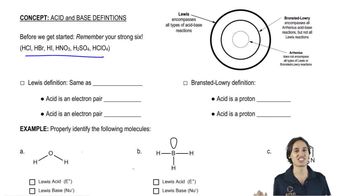
Lewis acids are defined as electron pair acceptors, while Lewis bases are electron pair donors. This concept is fundamental in understanding acid-base reactions in organic chemistry, as it expands the traditional Brønsted-Lowry definitions. The strength of a Lewis acid is influenced by its ability to stabilize the resulting complex after accepting an electron pair.
Recommended video:
Guided course
02:49
The Lewis definition of acids and bases.

Charge Density

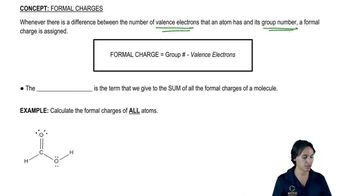
Charge density refers to the distribution of electric charge over a given volume. In the context of Lewis acids, a higher charge density typically indicates a stronger acid, as it can attract electron pairs more effectively. For cations like Al³⁺ and B³⁺, the charge density is influenced by their ionic radii and the magnitude of their positive charge.
Recommended video:
Guided course
01:34
Calculating formal and net charge.

Stability of the Conjugate Base

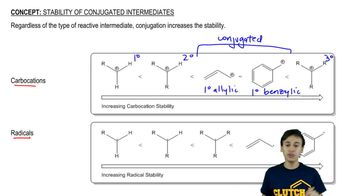
The stability of the conjugate base formed after a Lewis acid accepts an electron pair is crucial in determining the strength of the acid. A more stable conjugate base will favor the forward reaction, making the original species a stronger Lewis acid. Factors such as electronegativity and resonance can significantly affect the stability of the conjugate base.
Recommended video:
Guided course
04:31
Stability of Conjugated Intermediates