Ch. 2 - General Chemistry Translated: Finding the Electrons
Mullins - Organic Chemistry: A Learner Centered Approach 1st Edition
Mullins1st EditionOrganic Chemistry: A Learner Centered ApproachISBN: 9780137566471Not the one you use?Change textbook
Chapter 1, Problem 41

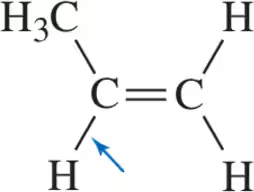
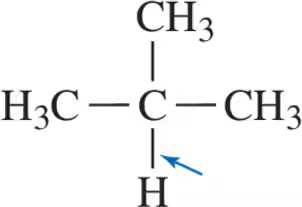
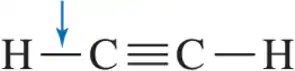
Rank the following molecules by the length of the indicated bond from shortest to longest.
(a) Structural representation of a carbon-carbon double bond with hydrogen atoms, indicating bond length comparison.
(b) Structural formula of a carbon atom with attached groups, highlighting a bond with a blue arrow.
(c) Structural representation of a molecule with a triple bond, indicating bond length comparison.

Verified step by step guidance
1
Identify the type of bond in each molecule (e.g., single, double, or triple bond) and the atoms involved in the bond. Bond length is influenced by bond order and the size of the bonded atoms.
Recall that bond order is inversely proportional to bond length: triple bonds are shorter than double bonds, which are shorter than single bonds. Additionally, smaller atoms form shorter bonds compared to larger atoms.
Examine the periodic trends of the atoms involved in the bonds. For example, bonds involving smaller atoms (e.g., C-H) are shorter than those involving larger atoms (e.g., C-I).
Compare the bond types and the atomic sizes for the indicated bonds in each molecule. Rank the bonds based on their expected lengths, starting with the shortest (highest bond order and/or smallest atoms) and ending with the longest (lowest bond order and/or largest atoms).
Verify your ranking by considering any additional factors, such as resonance or hybridization, that might influence bond length. For example, resonance can lead to partial double-bond character, which shortens the bond compared to a pure single bond.

Verified video answer for a similar problem:

This video solution was recommended by our tutors as helpful for the problem above.
Video duration:
4m
Was this helpful?

Key Concepts

Here are the essential concepts you must grasp in order to answer the question correctly.

Bond Length

Bond length refers to the distance between the nuclei of two bonded atoms. It is influenced by factors such as atomic size, bond order, and the presence of lone pairs. Generally, shorter bonds are stronger due to greater overlap of atomic orbitals, while longer bonds tend to be weaker and more reactive.
Recommended video:
Guided course
06:00
Single bonds, double bonds, and triple bonds.

Bond Order

Bond order is a measure of the number of chemical bonds between a pair of atoms. It is calculated as the difference between the number of bonding and antibonding electrons divided by two. Higher bond orders indicate stronger and shorter bonds, while lower bond orders correspond to weaker and longer bonds.
Recommended video:
Guided course
06:00
Single bonds, double bonds, and triple bonds.

Electronegativity

Electronegativity is the tendency of an atom to attract electrons in a chemical bond. Differences in electronegativity between bonded atoms can affect bond length; for instance, bonds between atoms with similar electronegativities tend to be shorter and stronger. This concept is crucial for understanding the nature of bonds in different molecules.
Recommended video:
Guided course
1:47
Electronegativity