Ch. 2 - General Chemistry Translated: Finding the Electrons
Mullins - Organic Chemistry: A Learner Centered Approach 1st Edition
Mullins1st EditionOrganic Chemistry: A Learner Centered ApproachISBN: 9780137566471Not the one you use?Change textbook
Chapter 1, Problem 45

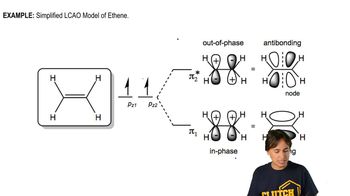
How might electrons be excited from π to π* based on the molecular orbital diagram shown? [This will be relevant in Chapter 21.]
<IMAGE>

Verified step by step guidance
1
Examine the molecular orbital diagram provided. The diagram shows two molecular orbitals: the bonding π orbital (lower energy) and the antibonding π* orbital (higher energy). Electrons are initially located in the π orbital.
Understand the concept of electronic excitation. Electrons can be promoted from the bonding π orbital to the antibonding π* orbital when energy is absorbed, typically in the form of ultraviolet or visible light.
Identify the energy gap between the π and π* orbitals. The energy required for excitation corresponds to the difference in energy levels between these orbitals, which is depicted in the diagram.
Consider the role of light absorption. When a molecule absorbs a photon with energy matching the energy gap, the electron in the π orbital is excited to the π* orbital. This process is fundamental to UV-Vis spectroscopy.
Relate this excitation to Chapter 21. This concept is relevant in understanding conjugated systems and their ability to absorb light, as conjugation reduces the energy gap between π and π* orbitals, making excitation easier.

Verified video answer for a similar problem:

This video solution was recommended by our tutors as helpful for the problem above.
Was this helpful?

Key Concepts

Here are the essential concepts you must grasp in order to answer the question correctly.

Molecular Orbital Theory

Molecular Orbital Theory describes how atomic orbitals combine to form molecular orbitals, which can be occupied by electrons. In this theory, electrons are delocalized over the entire molecule rather than being localized between individual atoms. The energy levels of these molecular orbitals dictate the stability and reactivity of the molecule, with bonding orbitals being lower in energy and antibonding orbitals being higher.
Recommended video:
Guided course
08:41
Review of Molecular Orbitals

π and π* Orbitals

In the context of molecular orbitals, π (pi) orbitals are formed from the lateral overlap of p orbitals, allowing for electron delocalization in systems like alkenes and aromatic compounds. The π* (pi star) orbital is the corresponding antibonding orbital, which is higher in energy than the π orbital. Electrons can be excited from the π to the π* orbital when energy is absorbed, typically through UV or visible light.
Recommended video:
Guided course
08:41
Review of Molecular Orbitals

Electron Excitation

Electron excitation refers to the process where an electron absorbs energy and transitions from a lower energy state (such as a bonding orbital) to a higher energy state (such as an antibonding orbital). This process is crucial in understanding the electronic transitions that occur in molecules, particularly in photochemical reactions. The energy required for this transition corresponds to the difference in energy between the two orbitals involved.
Recommended video:
Guided course
03:54
The 18 and 16 Electron Rule