Chlorine exists as one of two isotopes with atomic masses of 34.969 amu (35Cl) and 36.966 amu (37Cl) . Calculate the relative abundance of 35Cl and 37Cl based on the average atomic mass of 35.453 amu.
Ch. 2 - General Chemistry Translated: Finding the Electrons

Mullins1st EditionOrganic Chemistry: A Learner Centered ApproachISBN: 9780137566471Not the one you use?Change textbook
All textbooks
Mullins 1st Edition
Ch. 2 - General Chemistry Translated: Finding the Electrons
Problem 4c
Mullins 1st Edition
Ch. 2 - General Chemistry Translated: Finding the Electrons
Problem 4cChapter 1, Problem 4c
How many valence shell electrons do each of the following elements contain? How many new bonds can each form?
(c) O
Verified step by step guidance1
Step 1: Determine the group number of oxygen in the periodic table. Oxygen is in Group 16 (or Group VI A in older notations). Elements in this group have 6 valence electrons.
Step 2: Recall that the number of valence electrons corresponds to the electrons in the outermost shell of an atom. For oxygen, this is 6 valence electrons.
Step 3: To determine how many new bonds oxygen can form, consider the octet rule. Atoms tend to form bonds to achieve a full outer shell of 8 electrons.
Step 4: Subtract the number of valence electrons from 8 to find the number of electrons oxygen needs to complete its octet. For oxygen, 8 - 6 = 2 electrons are needed.
Step 5: Conclude that oxygen can form 2 new bonds, as it needs 2 more electrons to complete its octet. These bonds can be single or part of a double bond, depending on the molecule.

Verified video answer for a similar problem:
This video solution was recommended by our tutors as helpful for the problem above.
Video duration:
2mWas this helpful?
Key Concepts
Here are the essential concepts you must grasp in order to answer the question correctly.
Valence Electrons
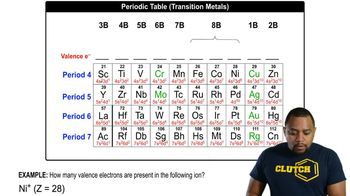
Valence electrons are the outermost electrons of an atom and are crucial for determining how an element interacts and bonds with others. For oxygen (O), which is in group 16 of the periodic table, there are six valence electrons. These electrons are involved in chemical bonding, influencing the element's reactivity and the types of bonds it can form.
Recommended video:
Guided course
Valence Electrons of Transition Metals
Covalent Bonds
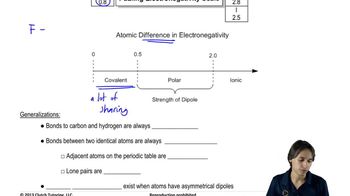
Covalent bonds are formed when two atoms share pairs of electrons, allowing them to achieve a full outer shell and greater stability. Oxygen typically forms two covalent bonds by sharing its six valence electrons with other atoms, such as hydrogen in water (H2O). This ability to form bonds is essential for understanding molecular structures and reactivity.
Recommended video:
Guided course
Differences between ionic, polar and covalent bonds
Octet Rule
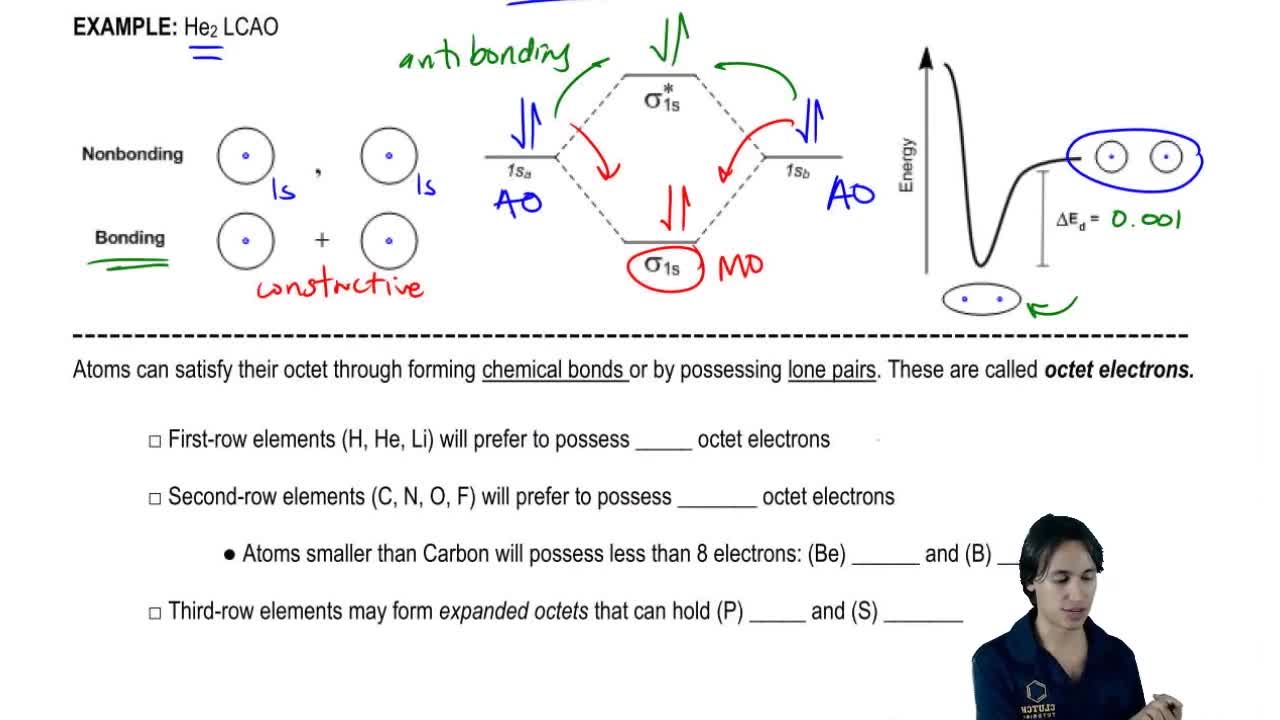
The octet rule states that atoms tend to form bonds in such a way that they have eight electrons in their valence shell, achieving a stable electron configuration similar to noble gases. For oxygen, which has six valence electrons, forming two bonds allows it to complete its octet, making it more stable. This principle is fundamental in predicting how elements will bond and interact in chemical reactions.
Recommended video:
Guided course
The octet rule.
Related Practice
Textbook Question
1
views
Textbook Question
Why is argon considered to be so stable that it is referred to as a noble gas?
7
views
Textbook Question
How many valence shell electrons do each of the following elements contain? How many new bonds can each form?
(a) C
1
views
Textbook Question
How many valence shell electrons do each of the following elements contain? How many new bonds can each form?
(b) N
2
views
Textbook Question
Bromine-79 (50.7% abundance) has an atomic mass of 78.918 amu, whereas bromine-81 (49.3% abundance) has an atomic mass of 80.916 amu. From these data, calculate the average atomic mass of bromine that you would expect to see in the periodic table.
1
views
Textbook Question
Rank the following elements from least electronegative to most electronegative.
Na, Si, F, Mg, C, O, N
7
views