Ch. 2 - General Chemistry Translated: Finding the Electrons
Mullins - Organic Chemistry: A Learner Centered Approach 1st Edition
Mullins1st EditionOrganic Chemistry: A Learner Centered ApproachISBN: 9780137566471Not the one you use?Change textbook
Chapter 1, Problem 8

Chlorine exists as one of two isotopes with atomic masses of 34.969 amu (35Cl) and 36.966 amu (37Cl) . Calculate the relative abundance of 35Cl and 37Cl based on the average atomic mass of 35.453 amu.

Verified step by step guidance
1
Define the variables: Let the relative abundance of ³⁵Cl be x, and the relative abundance of ³⁷Cl be (1 - x), since the total abundance must equal 1.
Write the equation for the average atomic mass of chlorine: 35.453 = (34.969 × x) + (36.966 × (1 - x)).
Distribute the terms in the equation: 35.453 = 34.969x + 36.966(1 - x), which expands to 35.453 = 34.969x + 36.966 - 36.966x.
Combine like terms: Simplify the equation to 35.453 = 36.966 - 1.997x.
Rearrange the equation to solve for x: Subtract 36.966 from both sides, then divide by -1.997 to isolate x. The value of x represents the relative abundance of ³⁵Cl, and (1 - x) gives the relative abundance of ³⁷Cl.

Verified video answer for a similar problem:

This video solution was recommended by our tutors as helpful for the problem above.
Video duration:
6m
Was this helpful?

Key Concepts

Here are the essential concepts you must grasp in order to answer the question correctly.

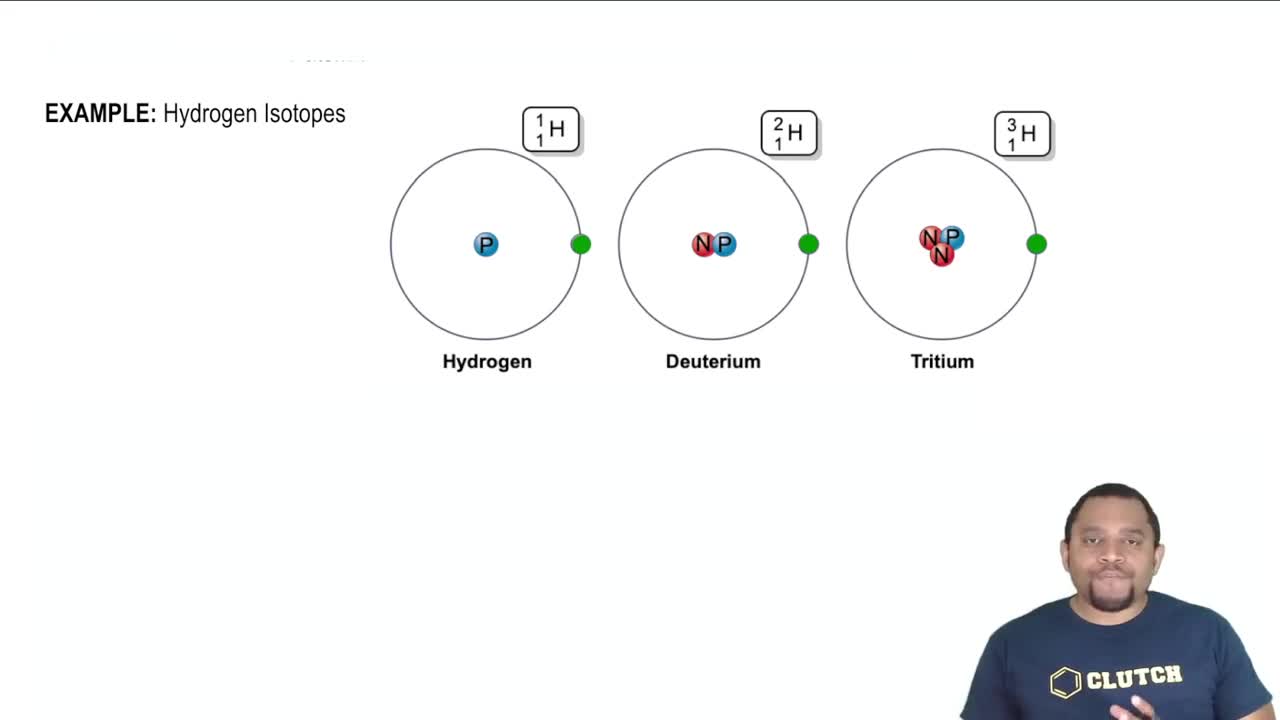
Isotopes

Isotopes are variants of a chemical element that have the same number of protons but different numbers of neutrons, resulting in different atomic masses. For chlorine, the isotopes ³⁵Cl and ³⁷Cl have atomic masses of 34.969 amu and 36.966 amu, respectively. Understanding isotopes is crucial for calculations involving average atomic mass and relative abundance.
Recommended video:
Guided course
03:06
Understanding the hydrogen isotopes.

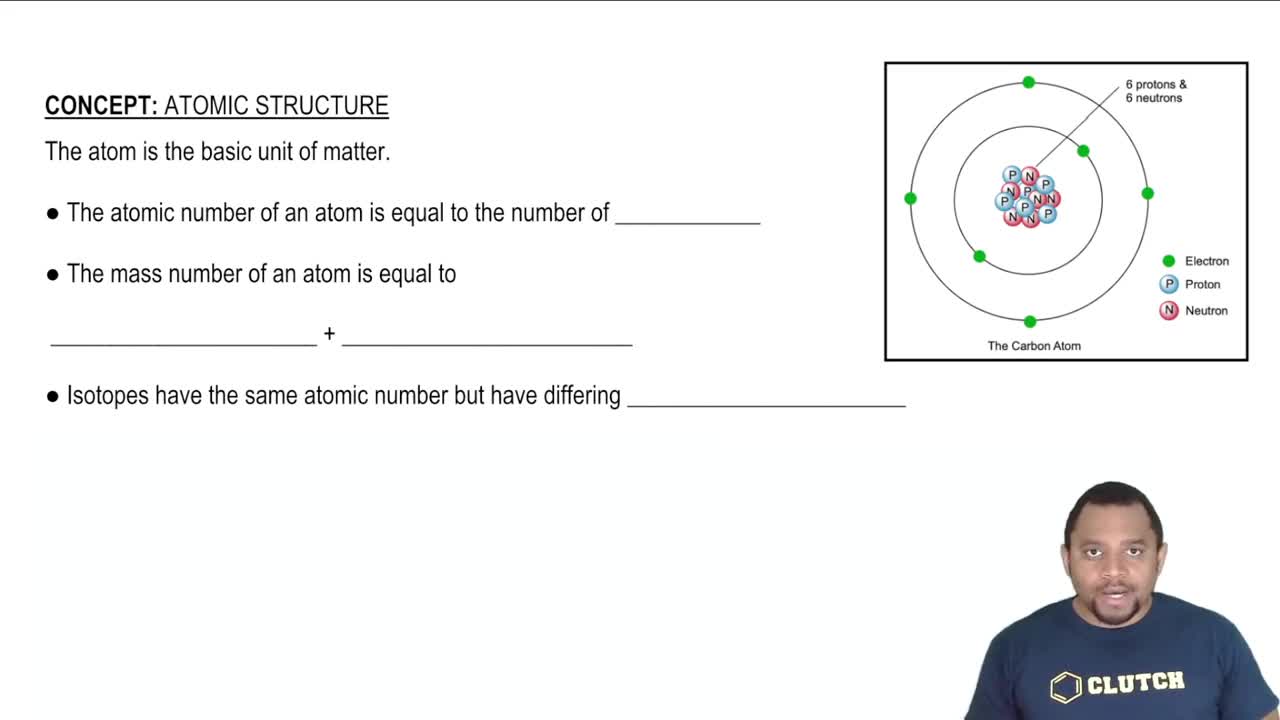
Average Atomic Mass

The average atomic mass of an element is a weighted average of the masses of its isotopes, taking into account their relative abundances. In this case, the average atomic mass of chlorine is given as 35.453 amu. This value is essential for determining the proportions of each isotope present in a sample.
Recommended video:
Guided course
01:44
The difference between atomic numbers and atomic mass.

Relative Abundance

Relative abundance refers to the proportion of each isotope of an element present in a sample, usually expressed as a percentage. To calculate the relative abundance of ³⁵Cl and ³⁷Cl, one can set up equations based on the average atomic mass and the known masses of the isotopes. This concept is fundamental for understanding how isotopes contribute to the overall atomic mass of an element.
Recommended video:
Guided course
04:32
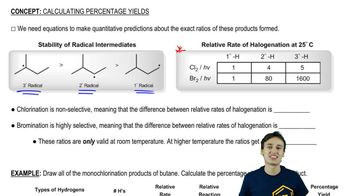
Explaining relative rates of halogenation.