Ch. 2 - General Chemistry Translated: Finding the Electrons
Mullins - Organic Chemistry: A Learner Centered Approach 1st Edition
Mullins1st EditionOrganic Chemistry: A Learner Centered ApproachISBN: 9780137566471Not the one you use?Change textbook
Chapter 1, Problem 14a

How many electrons does an atom of each of the following elements need to lose to achieve a noble gas configuration? By losing that many electrons, which noble gas configuration is achieved?
(a) Beryllium

Verified step by step guidance
1
Step 1: Identify the group number of beryllium (Be) in the periodic table. Beryllium is in Group 2, meaning it has 2 valence electrons in its outermost shell.
Step 2: Recall that atoms achieve a noble gas configuration by either losing or gaining electrons to have a full outer shell. For beryllium, losing electrons is the most favorable option because it is a metal.
Step 3: Determine the nearest noble gas to beryllium in the periodic table. The nearest noble gas is helium (He), which has a stable electron configuration of 1s².
Step 4: Write the electron configuration of beryllium: Be = 1s² 2s². To achieve the helium configuration, beryllium needs to lose the 2 electrons in the 2s orbital.
Step 5: Conclude that beryllium needs to lose 2 electrons to achieve the noble gas configuration of helium (He).

Verified video answer for a similar problem:

This video solution was recommended by our tutors as helpful for the problem above.
Video duration:
3m
Was this helpful?

Key Concepts

Here are the essential concepts you must grasp in order to answer the question correctly.

Noble Gas Configuration

Noble gas configuration refers to the electron arrangement of noble gases, which have full outer electron shells, making them stable and unreactive. Atoms tend to lose, gain, or share electrons to achieve this stable configuration, typically resembling the nearest noble gas in the periodic table.
Recommended video:
Guided course
02:14
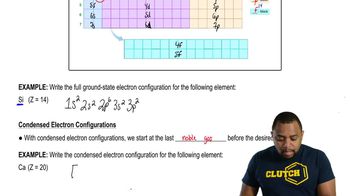
The Electron Configuration

Electron Loss in Metals

Metals, such as beryllium, typically lose electrons to achieve a stable electron configuration. Beryllium, with two valence electrons, will lose both to attain the electron configuration of helium, the nearest noble gas, which has a full outer shell.
Recommended video:
Guided course
04:56
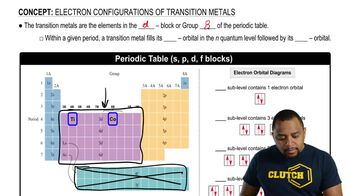
Electron Configurations of Transition Metals

Periodic Table Trends

The periodic table displays trends in atomic structure and reactivity. Elements in the same group often exhibit similar behaviors regarding electron loss or gain. Understanding these trends helps predict how many electrons an element like beryllium will lose to achieve a noble gas configuration.
Recommended video:
Guided course
02:24
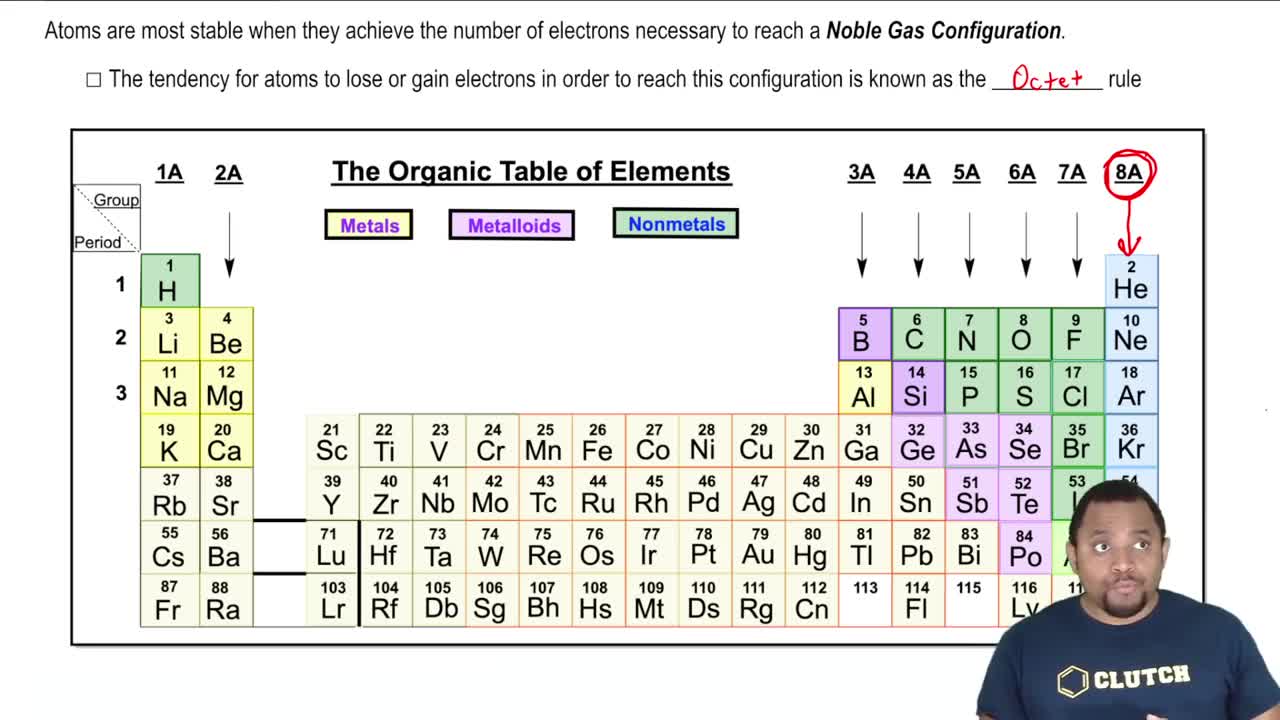
The most important parts of the periodic table for organic chemistry