Ch. 2 - General Chemistry Translated: Finding the Electrons
Mullins - Organic Chemistry: A Learner Centered Approach 1st Edition
Mullins1st EditionOrganic Chemistry: A Learner Centered ApproachISBN: 9780137566471Not the one you use?Change textbook
Chapter 1, Problem 13b

Choose the larger atom in each pair.
(b) O or F

Verified step by step guidance
1
Step 1: Understand the periodic trend for atomic size. Atomic size generally decreases across a period (left to right) in the periodic table due to increasing nuclear charge, which pulls the electrons closer to the nucleus.
Step 2: Locate the elements oxygen (O) and fluorine (F) on the periodic table. Both elements are in the same period (Period 2). Oxygen is in Group 16, while fluorine is in Group 17.
Step 3: Compare the nuclear charge of the two elements. Fluorine has a higher nuclear charge than oxygen because it has more protons in its nucleus. This stronger nuclear attraction pulls the electrons closer to the nucleus, making fluorine smaller in size.
Step 4: Conclude that oxygen, having a lower nuclear charge and less effective pull on its electrons, is the larger atom compared to fluorine.
Step 5: To summarize, the larger atom between oxygen (O) and fluorine (F) is oxygen (O).

Verified video answer for a similar problem:

This video solution was recommended by our tutors as helpful for the problem above.
Was this helpful?

Key Concepts

Here are the essential concepts you must grasp in order to answer the question correctly.

Atomic Size

Atomic size refers to the distance from the nucleus of an atom to the outermost shell of electrons. Generally, atomic size increases down a group in the periodic table due to the addition of electron shells, while it decreases across a period from left to right due to increased nuclear charge attracting electrons more strongly.
Recommended video:
Guided course
01:44
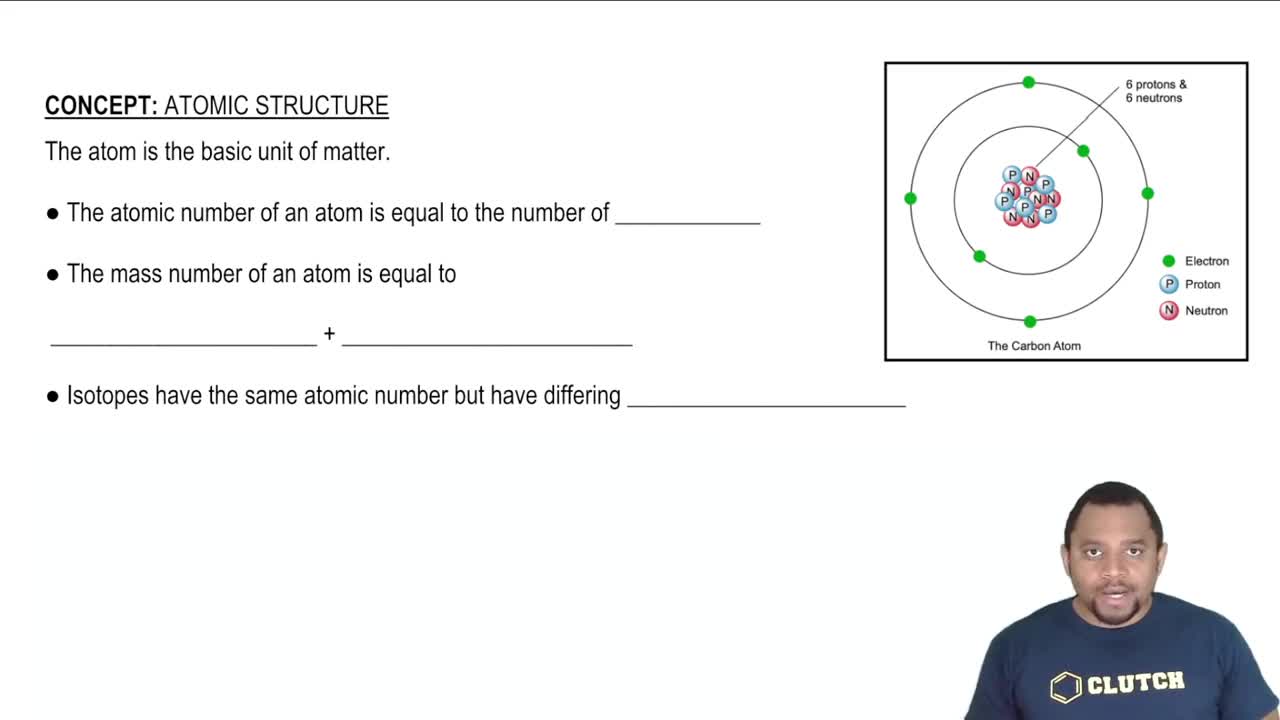
The difference between atomic numbers and atomic mass.

Periodic Trends

Periodic trends are patterns observed in the periodic table that describe how certain properties of elements change across periods and groups. For example, atomic radius decreases across a period and increases down a group, which is essential for comparing the sizes of atoms like oxygen (O) and fluorine (F).
Recommended video:
Guided course
03:43
The radical stability trend.

Electronegativity

Electronegativity is a measure of an atom's ability to attract and hold onto electrons in a chemical bond. Fluorine is the most electronegative element, which influences its atomic size and behavior in comparison to oxygen. Understanding electronegativity helps in predicting how atoms interact and bond with each other.
Recommended video:
Guided course
1:47
Electronegativity