Ch. 2 - General Chemistry Translated: Finding the Electrons
Mullins - Organic Chemistry: A Learner Centered Approach 1st Edition
Mullins1st EditionOrganic Chemistry: A Learner Centered ApproachISBN: 9780137566471Not the one you use?Change textbook
Chapter 1, Problem 29c

Draw the Lewis structure for the following ions. Be sure to calculate the formal charge of each atom to confirm that your structure is correct.
(c) BH4-

Verified step by step guidance
1
Step 1: Begin by determining the total number of valence electrons in the BH⁻₄ ion. Boron (B) has 3 valence electrons, hydrogen (H) has 1 valence electron each, and the negative charge adds 1 extra electron. Therefore, the total number of valence electrons is 3 + (4 × 1) + 1 = 8.
Step 2: Place boron (B) as the central atom since it is less electronegative than hydrogen. Arrange the four hydrogen atoms around boron.
Step 3: Connect each hydrogen atom to boron using a single bond. Each bond represents 2 electrons, so 4 bonds will use up 8 electrons, which matches the total number of valence electrons calculated in Step 1.
Step 4: Calculate the formal charge for each atom to confirm the structure. The formal charge formula is: Formal Charge = Valence Electrons - (Nonbonding Electrons + Bonding Electrons/2). For boron, it has 3 valence electrons, 0 nonbonding electrons, and 8 bonding electrons (4 bonds × 2 electrons per bond). Formal Charge of B = 3 - (0 + 8/2) = 0. For each hydrogen atom, it has 1 valence electron, 0 nonbonding electrons, and 2 bonding electrons. Formal Charge of H = 1 - (0 + 2/2) = 0.
Step 5: Verify that the structure satisfies the octet rule for boron and the duet rule for hydrogen. Boron has 8 electrons around it (4 bonds × 2 electrons per bond), fulfilling the octet rule. Each hydrogen atom has 2 electrons (1 bond × 2 electrons per bond), fulfilling the duet rule. The structure is valid and stable.

Verified video answer for a similar problem:

This video solution was recommended by our tutors as helpful for the problem above.
Video duration:
3m
Was this helpful?

Key Concepts

Here are the essential concepts you must grasp in order to answer the question correctly.

Lewis Structures

Lewis structures are diagrams that represent the bonding between atoms in a molecule and the lone pairs of electrons that may exist. They use dots to represent valence electrons and lines to represent bonds. Understanding how to draw Lewis structures is essential for visualizing molecular geometry and predicting reactivity.
Recommended video:
Guided course
04:12
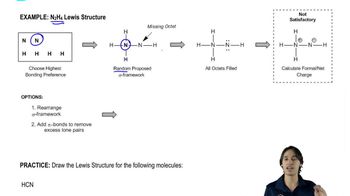
Drawing the Lewis Structure for N2H4.

Formal Charge

Formal charge is a theoretical charge assigned to an atom in a molecule, calculated based on the number of valence electrons, the number of non-bonding electrons, and half the number of bonding electrons. It helps in assessing the stability of a Lewis structure; structures with formal charges closest to zero are generally more stable. Calculating formal charges is crucial for confirming the accuracy of a Lewis structure.
Recommended video:
Guided course
01:34
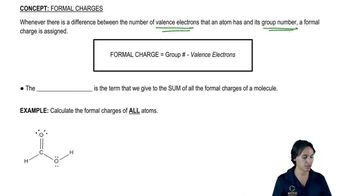
Calculating formal and net charge.

Ionic Compounds

Ionic compounds are formed when atoms transfer electrons, resulting in the formation of charged ions. In the case of BH⁻₄, the negative charge indicates that the molecule has gained an extra electron, affecting its Lewis structure and formal charge calculations. Understanding the nature of ionic compounds is important for predicting their properties and behavior in chemical reactions.
Recommended video:
Guided course
01:40
Defining meso compounds.