Ch. 2 - General Chemistry Translated: Finding the Electrons
Mullins - Organic Chemistry: A Learner Centered Approach 1st Edition
Mullins1st EditionOrganic Chemistry: A Learner Centered ApproachISBN: 9780137566471Not the one you use?Change textbook
Chapter 1, Problem 30a

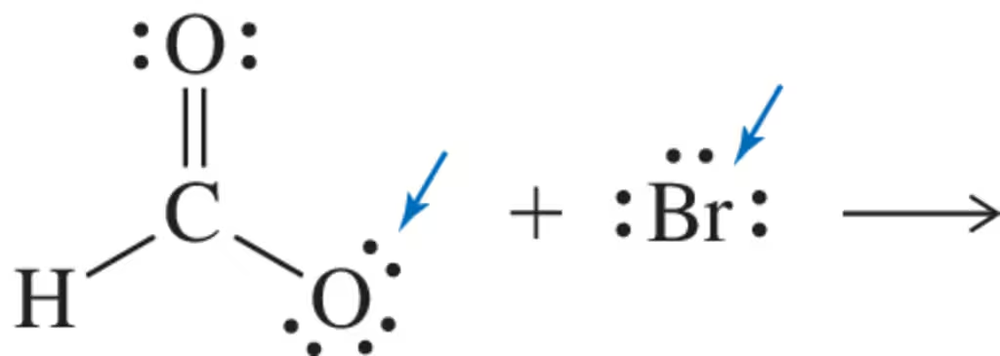
Calculate the formal charge of the indicated atoms in the ions shown.
Diagram showing molecular structures with arrows indicating atoms for formal charge calculation.

Verified step by step guidance
1
Step 1: Recall the formula for calculating formal charge: Formal Charge = (Valence Electrons) - (Non-bonding Electrons) - (1/2 × Bonding Electrons). This formula helps determine the charge on an atom within a molecule or ion.
Step 2: Identify the atom whose formal charge needs to be calculated and determine the number of valence electrons it has based on its position in the periodic table. For example, carbon has 4 valence electrons, oxygen has 6, etc.
Step 3: Count the number of non-bonding electrons (lone pairs) around the atom. These are electrons that are not involved in bonding and are directly associated with the atom.
Step 4: Count the number of bonding electrons (shared electrons in bonds) around the atom. Since each bond consists of two electrons, divide the total bonding electrons by 2 to account for the atom's share.
Step 5: Substitute the values into the formal charge formula and simplify to determine the formal charge of the indicated atom. Repeat this process for each atom in the ion as needed.

Verified video answer for a similar problem:

This video solution was recommended by our tutors as helpful for the problem above.
Video duration:
3m
Was this helpful?

Key Concepts

Here are the essential concepts you must grasp in order to answer the question correctly.

Formal Charge

Formal charge is a theoretical charge assigned to an atom in a molecule, calculated based on the number of valence electrons, the number of non-bonding electrons, and half the number of bonding electrons. It helps in determining the most stable structure of a molecule by minimizing the formal charges across the atoms. The formula is: Formal Charge = Valence Electrons - (Non-bonding Electrons + 1/2 Bonding Electrons).
Recommended video:
Guided course
01:34
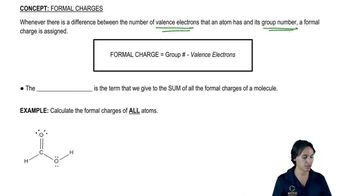
Calculating formal and net charge.

Lewis Structures

Lewis structures are diagrams that represent the bonding between atoms in a molecule and the lone pairs of electrons that may exist. They provide a visual way to understand the arrangement of electrons and the connectivity of atoms, which is essential for calculating formal charges. Drawing accurate Lewis structures is the first step in determining the formal charge of specific atoms.
Recommended video:
Guided course
04:12
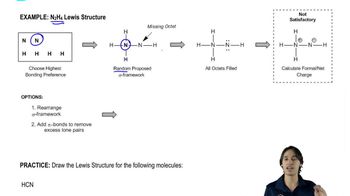
Drawing the Lewis Structure for N2H4.

Ionic Species

Ionic species are atoms or molecules that have gained or lost electrons, resulting in a net charge. Understanding the nature of these ions is crucial when calculating formal charges, as the charge affects the distribution of electrons in the Lewis structure. Recognizing whether an ion is positively or negatively charged helps in applying the formal charge formula correctly to the indicated atoms.
Recommended video:
Guided course
11:33
Differences between ionic, polar and covalent bonds