Ch. 19 - Nucleophilic Acyl Substitution II: Carboxylic Acid Derivatives
Mullins - Organic Chemistry: A Learner Centered Approach 1st Edition
Mullins1st EditionOrganic Chemistry: A Learner Centered ApproachISBN: 9780137566471Not the one you use?Change textbook
Chapter 18, Problem 41

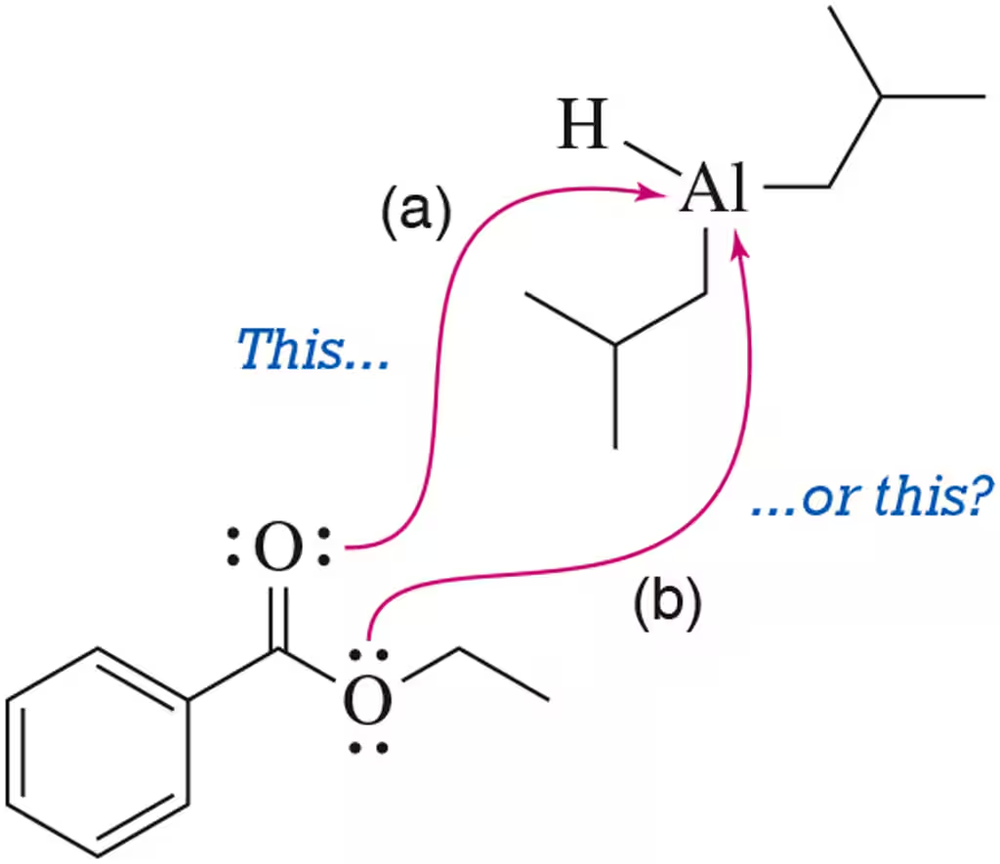
When the ester attacked the aluminum of DIBAl-H, why did the carbonyl oxygen attack preferentially over the alkoxy oxygen?
Diagram showing ester oxygen options for attacking DIBAL-H: carbonyl oxygen (a) or alkoxy oxygen (b).

Verified step by step guidance
1
Understand the structure of DIBAl-H: DIBAl-H stands for diisobutylaluminum hydride, which is a reducing agent commonly used in organic chemistry to reduce esters to aldehydes.
Identify the reactive sites in the ester: An ester has a carbonyl group (C=O) and an alkoxy group (OR). The carbonyl oxygen is more electronegative and has a partial negative charge, making it a potential site for nucleophilic attack.
Consider the mechanism of reduction: DIBAl-H is known to coordinate with the carbonyl oxygen due to its higher electronegativity compared to the alkoxy oxygen. This coordination is crucial for the reduction process.
Analyze the steric and electronic factors: The carbonyl oxygen is less hindered and more accessible for attack compared to the alkoxy oxygen, which is part of a larger group. Additionally, the carbonyl oxygen's lone pairs are more available for interaction with the aluminum.
Conclude why the carbonyl oxygen attacks preferentially: The combination of electronic factors (higher electronegativity and partial negative charge) and steric accessibility makes the carbonyl oxygen the preferred site for attack by the aluminum in DIBAl-H, facilitating the reduction of the ester to an aldehyde.

Verified video answer for a similar problem:

This video solution was recommended by our tutors as helpful for the problem above.
Video duration:
5m
Was this helpful?

Key Concepts

Here are the essential concepts you must grasp in order to answer the question correctly.

Nucleophilicity

Nucleophilicity refers to the ability of an atom or molecule to donate a pair of electrons to an electrophile, forming a chemical bond. In the context of the reaction with DIBAl-H, the carbonyl oxygen is more nucleophilic than the alkoxy oxygen due to its partial negative charge and the resonance stabilization of the carbonyl group, making it more reactive towards electrophilic centers like aluminum.
Recommended video:
Guided course
08:27
Nucleophilic Addition

Electrophilic Centers

Electrophilic centers are atoms or regions in a molecule that are electron-deficient and can accept electron pairs from nucleophiles. In DIBAl-H, the aluminum atom is an electrophilic center due to its incomplete octet and positive charge, making it susceptible to attack by nucleophiles such as the carbonyl oxygen in esters.
Recommended video:
Guided course
03:
Nucleophile or Electrophile

Resonance Stabilization

Resonance stabilization occurs when a molecule can distribute its electron density over multiple structures, lowering its energy and increasing stability. In esters, the carbonyl group benefits from resonance, as the lone pair on the oxygen can delocalize into the carbon-oxygen double bond, enhancing the nucleophilicity of the carbonyl oxygen compared to the alkoxy oxygen, which lacks such stabilization.
Recommended video:
Guided course
03:43
The radical stability trend.