Ch. 19 - Nucleophilic Acyl Substitution II: Carboxylic Acid Derivatives
Mullins - Organic Chemistry: A Learner Centered Approach 1st Edition
Mullins1st EditionOrganic Chemistry: A Learner Centered ApproachISBN: 9780137566471Not the one you use?Change textbook
Chapter 18, Problem 47b

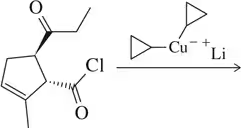
Predict the product of the following reactions.
(b) Chemical reaction diagram showing reactants with chlorine and carbonyl groups, and a copper-lithium reagent for product prediction.

Verified step by step guidance
1
Identify the type of reaction: The image shows a reaction between an acyl chloride and a lithium diorganocuprate (Gilman reagent). This is a nucleophilic acyl substitution reaction.
Understand the role of the Gilman reagent: Lithium diorganocuprates are used to perform conjugate additions to α,β-unsaturated carbonyl compounds or to replace halides with alkyl groups.
Analyze the structure of the acyl chloride: The acyl chloride has a five-membered ring with a chlorine atom attached to the carbonyl carbon. This is the site where the nucleophilic attack will occur.
Predict the nucleophilic attack: The Gilman reagent will attack the carbonyl carbon, replacing the chlorine atom with the cyclopropyl group from the reagent.
Consider stereochemistry: Since the reaction involves a cyclic structure, consider any stereochemical implications of the nucleophilic substitution, ensuring the correct orientation of substituents in the final product.

Verified video answer for a similar problem:

This video solution was recommended by our tutors as helpful for the problem above.
Was this helpful?

Key Concepts

Here are the essential concepts you must grasp in order to answer the question correctly.

Organocuprate Reagents

Organocuprate reagents, such as the one depicted with copper and lithium, are used in organic synthesis for nucleophilic substitution reactions. They are particularly effective in replacing halides like chlorine with carbon-based groups. In this reaction, the organocuprate will likely facilitate the substitution of the chlorine atom with the cyclopropyl group, leading to the formation of a new carbon-carbon bond.
Recommended video:

Nucleophilic Substitution

Nucleophilic substitution is a fundamental reaction mechanism where a nucleophile replaces a leaving group in a molecule. In the given reaction, the chlorine atom acts as the leaving group, and the organocuprate reagent serves as the nucleophile. This process is crucial for forming new carbon-carbon bonds, which is a common goal in organic synthesis.
Recommended video:
Guided course
01:47
Nucleophiles and Electrophiles can react in Substitution Reactions.

Stereochemistry in Reactions

Stereochemistry involves the spatial arrangement of atoms in molecules and its impact on chemical reactions. In the provided reaction, the stereochemistry of the reactants and the product must be considered, especially since the reactant contains a chiral center. The configuration of the product will depend on the stereochemical course of the nucleophilic substitution, which can influence the reaction's outcome and the properties of the product.
Recommended video:
1:38
Polymer Stereochemistry Concept 1