Ch. 16 - Metals in Organic Chemistry
Mullins - Organic Chemistry: A Learner Centered Approach 1st Edition
Mullins1st EditionOrganic Chemistry: A Learner Centered ApproachISBN: 9780137566471Not the one you use?Change textbook
Chapter 15, Problem 58

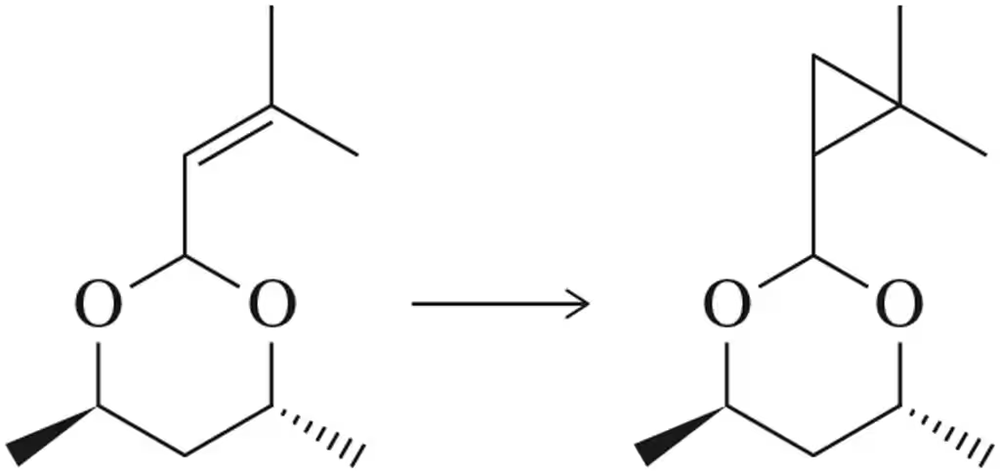
The following transformation is used as an early step in the synthesis of cilastatin, a drug used to counter antibiotic resistance. Identify a possible reagent for this step.
Chemical reaction diagram showing the transformation of a carbene intermediate in cilastatin synthesis.

Verified step by step guidance
1
Analyze the transformation: Examine the structural changes between the starting material and the product. Look for functional group changes, bond formations, or bond cleavages.
Identify the functional groups involved: Determine if there are any key functional groups (e.g., alcohols, ketones, carboxylic acids, amines) that are being introduced, removed, or modified during the transformation.
Determine the type of reaction: Based on the observed changes, classify the reaction type (e.g., oxidation, reduction, substitution, elimination, or addition). For example, if a hydroxyl group is converted to a carbonyl group, it suggests an oxidation reaction.
Propose a reagent: Based on the reaction type, suggest a reagent that is commonly used for such transformations. For instance, if the reaction involves oxidation, reagents like PCC (Pyridinium chlorochromate) or KMnO₄ might be appropriate.
Verify compatibility: Ensure that the proposed reagent is compatible with the other functional groups in the molecule and does not cause unwanted side reactions. Consider mild or selective reagents if necessary.

Verified video answer for a similar problem:

This video solution was recommended by our tutors as helpful for the problem above.
Video duration:
2m
Was this helpful?

Key Concepts

Here are the essential concepts you must grasp in order to answer the question correctly.

Reagents in Organic Synthesis

Reagents are substances used in chemical reactions to facilitate the transformation of reactants into products. In organic synthesis, the choice of reagent is crucial as it can influence the reaction pathway, yield, and selectivity. Understanding the role of different reagents, such as oxidizing agents, reducing agents, or catalysts, is essential for designing effective synthetic routes.
Recommended video:
1:16
Synthesis of Amino Acids: Strecker Synthesis Example 1

Functional Groups

Functional groups are specific groups of atoms within molecules that are responsible for the characteristic chemical reactions of those molecules. Identifying the functional groups present in the starting materials and the desired product helps in predicting the types of reactions that can occur and the reagents that may be required. This knowledge is fundamental in organic synthesis, especially in drug development.
Recommended video:
Guided course
02:36
Identifying Functional Groups

Reaction Mechanisms

A reaction mechanism is a step-by-step description of the process by which reactants are converted into products. Understanding the mechanism provides insight into how and why certain reagents are used, as well as the intermediates formed during the reaction. This knowledge is vital for predicting the outcomes of reactions and for troubleshooting synthetic pathways in organic chemistry.
Recommended video:
Guided course
02:16
Heck Reaction Mechanism