Ch. 16 - Metals in Organic Chemistry
Mullins - Organic Chemistry: A Learner Centered Approach 1st Edition
Mullins1st EditionOrganic Chemistry: A Learner Centered ApproachISBN: 9780137566471Not the one you use?Change textbook
Chapter 15, Problem 44b

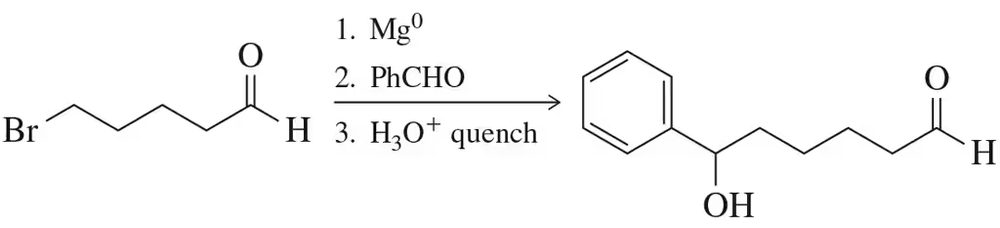
A chemist failed to generate the alcohol using the reaction shown here.
(b) How could the reaction conditions be modified to allow formation of the product?
Chemical reaction diagram showing a failed Grignard reaction with brominated compound, magnesium, and phenyl aldehyde.

Verified step by step guidance
1
Analyze the reaction provided in the problem. Identify the starting material, reagents, and the desired product. Pay attention to the functional groups involved and the type of reaction (e.g., reduction, oxidation, substitution, etc.).
For part (a), consider why the reaction might fail. Common reasons include the use of inappropriate reagents, incorrect reaction conditions (e.g., temperature, solvent, or pH), or the presence of competing side reactions. Evaluate whether the reagents used are suitable for the transformation of the starting material into the desired alcohol.
For part (b), propose general modifications to the reaction conditions. For example, if the reaction requires a reducing agent to convert a carbonyl group to an alcohol, ensure that a strong and selective reducing agent (e.g., NaBH₄ or LiAlH₄) is used. Alternatively, if the reaction involves a nucleophilic substitution, ensure the nucleophile and leaving group are compatible under the reaction conditions.
Consider the role of the solvent and temperature in the reaction. For instance, polar protic or aprotic solvents can influence the reactivity of reagents. Adjusting the temperature may also help drive the reaction forward or suppress side reactions.
Finally, ensure that the reaction mechanism is feasible under the proposed conditions. For example, if the reaction involves an intermediate, confirm that the intermediate can form and proceed to the desired product under the modified conditions.

Verified video answer for a similar problem:

This video solution was recommended by our tutors as helpful for the problem above.
Video duration:
5m
Was this helpful?

Key Concepts

Here are the essential concepts you must grasp in order to answer the question correctly.

Reaction Mechanisms

Understanding reaction mechanisms is crucial in organic chemistry as it describes the step-by-step process by which reactants transform into products. This includes identifying intermediates, transition states, and the role of catalysts. A failure to generate the desired alcohol may indicate that the proposed mechanism is not feasible under the given conditions.
Recommended video:
Guided course
02:16
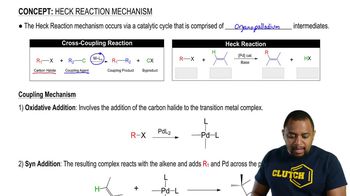
Heck Reaction Mechanism

Reaction Conditions

Reaction conditions encompass factors such as temperature, pressure, solvent, and concentration that can significantly influence the outcome of a chemical reaction. Modifying these conditions can enhance the likelihood of product formation. For instance, increasing temperature may provide the necessary energy to overcome activation barriers.
Recommended video:
1:18
EAS Reactions of Pyridine Example 1

Functional Group Reactivity

Functional group reactivity refers to how different functional groups behave in chemical reactions, influencing their ability to undergo transformations. In the context of alcohol formation, understanding the reactivity of the starting materials and the stability of the intermediates is essential. If the functional groups involved are not compatible, the reaction may not proceed as expected.
Recommended video:
Guided course
02:36
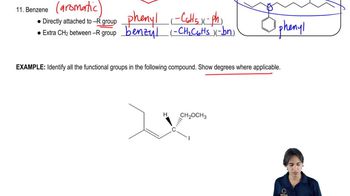
Identifying Functional Groups