Ch. 15 - Structural Identification II: Nuclear Magnetic Resonance Spectroscopy
Mullins - Organic Chemistry: A Learner Centered Approach 1st Edition
Mullins1st EditionOrganic Chemistry: A Learner Centered ApproachISBN: 9780137566471Not the one you use?Change textbook
Chapter 14, Problem 58f

For the following molecules, give the integration you would expect for the signal associated with the hydrogens at the labeled carbons. [Pay attention to the symmetry, or lack of symmetry, in the molecules.]
(f) Molecule with a bromine atom and labeled carbons 1 to 4, showing a cyclic ether structure.

Verified step by step guidance
1
Identify the labeled carbon atoms in the molecule and determine the number of hydrogen atoms attached to each labeled carbon.
Consider the symmetry of the molecule. Symmetrical molecules may have equivalent hydrogens that contribute to the same NMR signal.
For each labeled carbon, count the number of hydrogens directly attached. This count will determine the relative integration of the NMR signal for that set of hydrogens.
If the molecule has symmetrical parts, identify equivalent hydrogens that will have the same chemical environment and thus the same NMR signal.
Sum the hydrogens for each unique signal to determine the integration ratio. This ratio reflects the relative number of hydrogens contributing to each signal in the NMR spectrum.

Verified video answer for a similar problem:

This video solution was recommended by our tutors as helpful for the problem above.
Was this helpful?

Key Concepts

Here are the essential concepts you must grasp in order to answer the question correctly.

NMR Spectroscopy

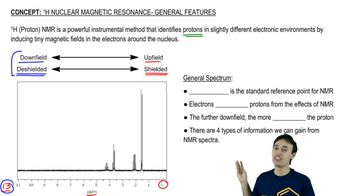
Nuclear Magnetic Resonance (NMR) Spectroscopy is a technique used to determine the structure of organic compounds by observing the magnetic properties of certain atomic nuclei. In NMR, the integration of signals corresponds to the relative number of hydrogen atoms contributing to each signal, providing insight into the molecular structure and symmetry.
Recommended video:
Guided course
10:06
General NMR Features

Integration of NMR Signals

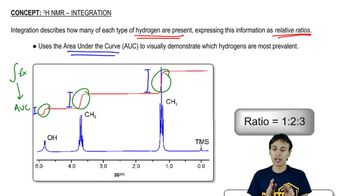
Integration in NMR refers to the area under the peaks in an NMR spectrum, which is proportional to the number of hydrogen atoms that produce each signal. By analyzing the integration values, chemists can deduce the relative number of hydrogens in different environments within a molecule, which is crucial for understanding the molecule's structure.
Recommended video:
Guided course
06:46
1H NMR Integration

Molecular Symmetry

Molecular symmetry in organic chemistry involves the spatial arrangement of atoms in a molecule that results in equivalent environments for certain atoms or groups. Symmetry affects the NMR signals by potentially reducing the number of unique signals, as equivalent hydrogens will produce the same signal, simplifying the analysis of the spectrum.
Recommended video:
Guided course
00:25
Determining Chirality with Plane of Symmetry