Textbook Question
Though it wasn't discussed, what coupling constant would you expect for Hₐ and H꜀ in the spectrum of trans-but-2-enoic acid in Figure 15.50? Justify your answer.
<IMAGE>
1
views

 Mullins 1st EditionCh. 15 - Structural Identification II: Nuclear Magnetic Resonance SpectroscopyProblem 40a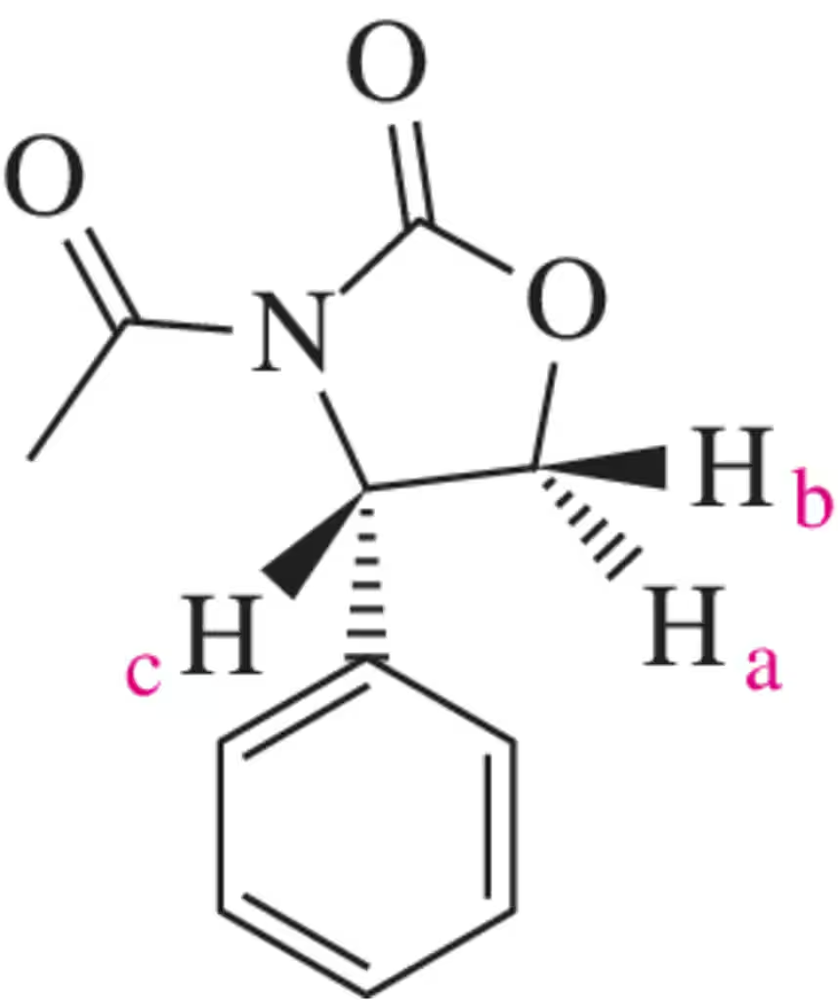
 Verified step by step guidance
 11:44
11:44
 02:54
02:54 02:02
02:02Though it wasn't discussed, what coupling constant would you expect for Hₐ and H꜀ in the spectrum of trans-but-2-enoic acid in Figure 15.50? Justify your answer.
<IMAGE>
A chemist made what was thought to be compound A or B. How could coupling constants between Ha and Hb be used to distinguish between the two isomers? [Hint: Draw a chair conformation of each.]
Replace Hₐ and H₆ in hexane with a deuterium. What is the relationship between the two products you obtain? Based on this, would you expect the two hydrogens to give one or two signals in the ¹H NMR spectrum?
Alkene hydrogens usually appear at similar chemical shifts between 5 and 6 ppm. The alkene hydrogens in the structure shown are very different. Rationalize the difference in chemical shifts between Hₐ and H₆ in the structure shown.
Draw the expected signal for a hydrogen with the following coupling constants.
(b) Hₐ : δ 3.34 (Jₐ꜀ = 9 , Jₐ₆ = 4 )
What coupling constant would you expect between Hₐ and H₆ in cyclopent-2-en-1-one?