Ch. 15 - Structural Identification II: Nuclear Magnetic Resonance Spectroscopy
Mullins - Organic Chemistry: A Learner Centered Approach 1st Edition
Mullins1st EditionOrganic Chemistry: A Learner Centered ApproachISBN: 9780137566471Not the one you use?Change textbook
Chapter 14, Problem 39

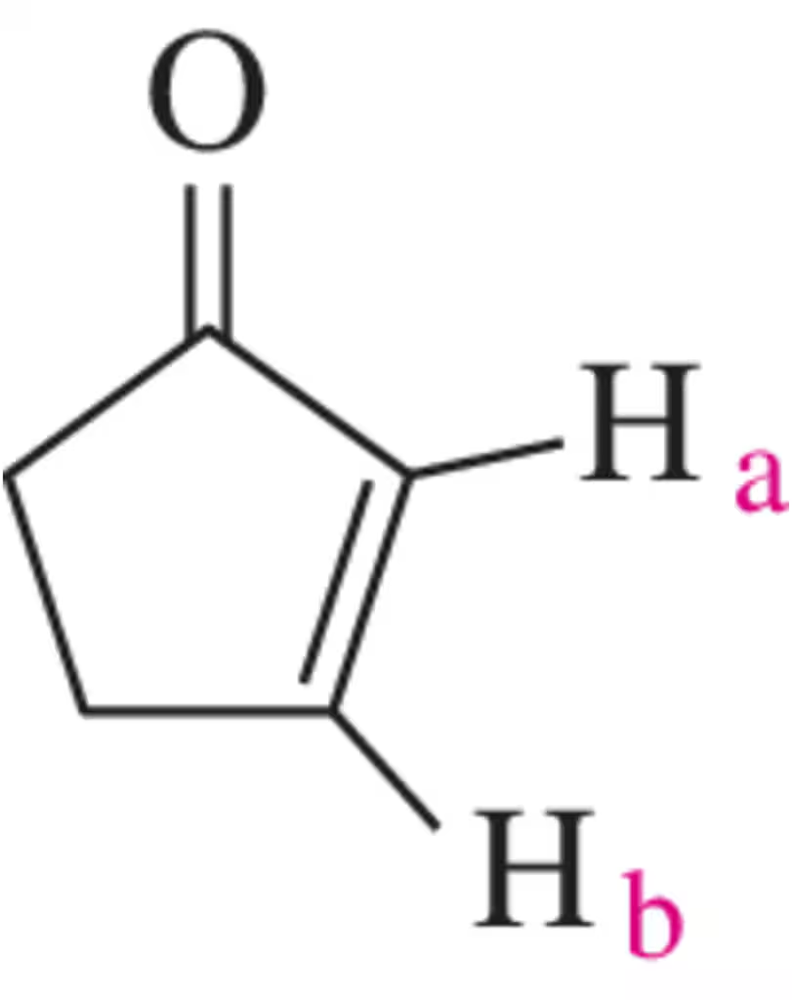
Alkene hydrogens usually appear at similar chemical shifts between 5 and 6 ppm. The alkene hydrogens in the structure shown are very different. Rationalize the difference in chemical shifts between Hₐ and H₆ in the structure shown.
Chemical structure with labeled alkene hydrogens Hₐ and H_b, highlighting differences in chemical shifts.

Verified step by step guidance
1
Identify the structure of the alkene and locate the hydrogens Hₐ and H₆. Note their positions relative to any substituents or functional groups.
Consider the electronic environment around each hydrogen. Factors such as electronegativity of nearby atoms, presence of electron-withdrawing or electron-donating groups, and hybridization can affect chemical shifts.
Analyze the effect of any substituents on the alkene. Electron-withdrawing groups can deshield nearby hydrogens, causing a downfield shift (higher ppm), while electron-donating groups can shield hydrogens, causing an upfield shift (lower ppm).
Evaluate the potential for any steric or conformational effects. The spatial arrangement of atoms can influence the electronic environment and thus the chemical shift.
Summarize how these factors contribute to the observed difference in chemical shifts between Hₐ and H₆, considering both electronic and steric influences.

Verified video answer for a similar problem:

This video solution was recommended by our tutors as helpful for the problem above.
Was this helpful?

Key Concepts

Here are the essential concepts you must grasp in order to answer the question correctly.

Chemical Shift in NMR Spectroscopy

Chemical shift in NMR spectroscopy refers to the resonant frequency of a nucleus relative to a standard in a magnetic field. It provides information about the electronic environment surrounding the nucleus. Factors such as electronegativity, hybridization, and the presence of electron-withdrawing or donating groups can influence the chemical shift, causing variations in the observed ppm values.
Recommended video:
Guided course
11:44
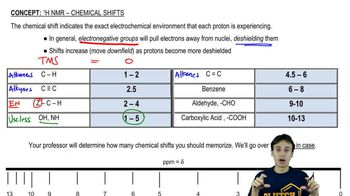
1H NMR Chemical Shifts

Shielding and Deshielding Effects

Shielding and deshielding effects describe how the electronic environment affects the magnetic field experienced by a nucleus. Shielding occurs when electron density around a nucleus increases, reducing the effective magnetic field and causing an upfield shift. Deshielding, on the other hand, occurs when electron density decreases, increasing the effective magnetic field and causing a downfield shift. These effects are crucial in understanding variations in chemical shifts.
Recommended video:
Guided course
04:18
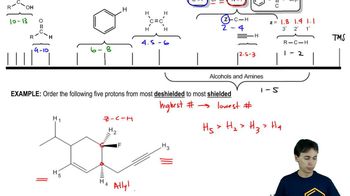
Ranking Shielded Protons

Alkene Proton Chemical Shifts

Alkene protons typically resonate between 5 and 6 ppm due to the sp2 hybridization of the carbon atoms, which affects the electron density around the protons. However, variations can occur due to factors like the presence of substituents, steric effects, or conjugation with other functional groups. These factors can alter the electron distribution, leading to differences in chemical shifts for alkene protons in different environments.
Recommended video:
Guided course
11:44
1H NMR Chemical Shifts