Ch. 13 - Alcohols, Ethers and Related Compounds: Substitution and Elimination
Mullins - Organic Chemistry: A Learner Centered Approach 1st Edition
Mullins1st EditionOrganic Chemistry: A Learner Centered ApproachISBN: 9780137566471Not the one you use?Change textbook
Chapter 12, Problem 105

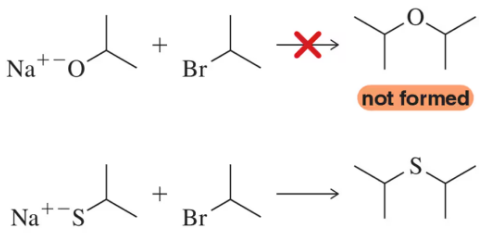
The reaction of alkoxides with haloalkanes is not a viable way to form ethers. (a) Why? (b) Why can thioethers be formed by an analogous reaction?

Verified step by step guidance
1
Step 1: Understand the reaction mechanism involved in the formation of ethers and thioethers. The reaction of alkoxides with haloalkanes typically follows an SN2 mechanism, where the nucleophile attacks the electrophilic carbon attached to the halogen.
Step 2: Consider the nature of the nucleophile. Alkoxides are strong bases and can lead to elimination reactions instead of substitution, especially with secondary or tertiary haloalkanes, due to steric hindrance and the formation of more stable alkenes.
Step 3: Analyze the reaction conditions. In the case of alkoxides reacting with haloalkanes, the strong basic nature of alkoxides can lead to the formation of alkenes via elimination rather than ethers via substitution.
Step 4: Compare the nucleophilicity and basicity of alkoxides and thiolates. Thiolates are less basic and more nucleophilic compared to alkoxides, which makes them more suitable for substitution reactions with haloalkanes, leading to the formation of thioethers.
Step 5: Conclude why thioethers can be formed. The lower basicity and higher nucleophilicity of thiolates allow them to effectively participate in SN2 reactions with haloalkanes, forming thioethers without competing elimination reactions.

Verified video answer for a similar problem:

This video solution was recommended by our tutors as helpful for the problem above.
Was this helpful?

Key Concepts

Here are the essential concepts you must grasp in order to answer the question correctly.

Alkoxide Reactivity

Alkoxides are strong nucleophiles that can react with haloalkanes through nucleophilic substitution. However, the reaction often leads to elimination rather than substitution, especially with secondary and tertiary haloalkanes, making ether formation inefficient. This is due to steric hindrance and the stability of the resulting alkene.
Recommended video:
Guided course
01:17
Reactivity of Molecules

Ethers vs. Thioethers

Ethers are formed by the reaction of alcohols with alkyl halides, while thioethers (or sulfides) can be formed through a similar reaction involving thiols. The sulfur atom in thioethers is larger and less electronegative than oxygen, allowing for more favorable nucleophilic substitution reactions with haloalkanes, thus facilitating thioether formation.
Recommended video:
Guided course
04:22
How to predict the products of Ether Cleavage.

Nucleophilic Substitution Mechanisms

Nucleophilic substitution can occur via two main mechanisms: SN1 and SN2. SN2 reactions involve a single concerted step where the nucleophile attacks the electrophile, while SN1 involves a two-step process with a carbocation intermediate. The choice of mechanism affects the feasibility of ether formation from alkoxides and the successful formation of thioethers.
Recommended video:
Guided course
01:47
Nucleophiles and Electrophiles can react in Substitution Reactions.