Ch. 13 - Alcohols, Ethers and Related Compounds: Substitution and Elimination
Mullins - Organic Chemistry: A Learner Centered Approach 1st Edition
Mullins1st EditionOrganic Chemistry: A Learner Centered ApproachISBN: 9780137566471Not the one you use?Change textbook
Chapter 12, Problem 47c

Suggest an alkene that, in two steps, could be converted into each of the following ketones. Each sequence should involve a pinacol rearrangement.
(c)

Verified step by step guidance
1
Step 1: Identify the target ketone structure. The ketone shown has a carbonyl group on the terminal carbon of a chain, with a branched alkyl group attached to the second carbon. This suggests that the precursor molecule must have a hydroxyl group on the carbon adjacent to the carbonyl group after rearrangement.
Step 2: Recall the pinacol rearrangement mechanism. This reaction involves a vicinal diol (two hydroxyl groups on adjacent carbons) undergoing acid-catalyzed rearrangement to form a ketone. Therefore, the intermediate before the rearrangement must be a vicinal diol.
Step 3: Determine the alkene that can lead to the vicinal diol. Alkenes can be converted into vicinal diols via hydroxylation reactions, such as using osmium tetroxide (OsO₄) or potassium permanganate (KMnO₄). The alkene should have the correct substitution pattern to yield the desired diol.
Step 4: Propose the alkene structure. The alkene should have a double bond between the second and third carbons of the chain, with a methyl group attached to the second carbon. This substitution pattern ensures that hydroxylation will produce the correct vicinal diol.
Step 5: Outline the two-step process. First, perform hydroxylation of the alkene to produce the vicinal diol. Second, subject the vicinal diol to acid-catalyzed pinacol rearrangement to yield the target ketone.

Verified video answer for a similar problem:

This video solution was recommended by our tutors as helpful for the problem above.
Video duration:
4m
Was this helpful?

Key Concepts

Here are the essential concepts you must grasp in order to answer the question correctly.

Alkene Reactivity

Alkenes are hydrocarbons that contain a carbon-carbon double bond, making them reactive intermediates in organic reactions. Their reactivity is primarily due to the presence of the π bond, which can participate in various reactions such as electrophilic addition, oxidation, and rearrangement. Understanding the types of reactions that alkenes can undergo is crucial for designing synthetic pathways to target compounds.
Recommended video:
2:09
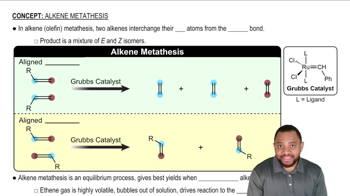
Alkene Metathesis Concept 1

Pinacol Rearrangement

The pinacol rearrangement is a chemical reaction that involves the conversion of a pinacol (a 1,2-diol) into a ketone or aldehyde through a rearrangement process. This reaction typically occurs under acidic conditions and involves the migration of an alkyl group and the formation of a carbocation intermediate. Recognizing how this rearrangement alters the structure of the starting material is essential for predicting the final product in synthetic routes.
Recommended video:
Guided course
06:08
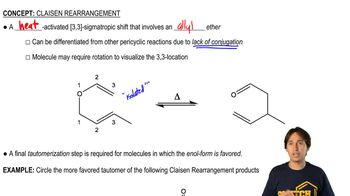
Definition of Claisen Rearrangement

Synthetic Strategy

A synthetic strategy in organic chemistry refers to the planned sequence of reactions and transformations used to construct a target molecule from simpler starting materials. This involves selecting appropriate reagents, reaction conditions, and intermediates to achieve the desired product efficiently. In the context of the question, devising a two-step synthesis involving an alkene and a pinacol rearrangement requires careful consideration of the starting materials and the desired ketone structure.
Recommended video:
Guided course
16:21
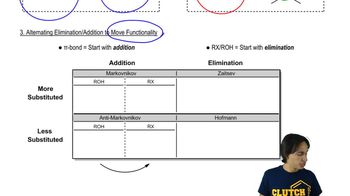
Review of Cheatsheet