Identify two different alcohols that can be dehydrated (one with rearrangement) to form the alkene shown.
Ch. 13 - Alcohols, Ethers and Related Compounds: Substitution and Elimination

Mullins1st EditionOrganic Chemistry: A Learner Centered ApproachISBN: 9780137566471Not the one you use?Change textbook
All textbooks
Mullins 1st Edition
Ch. 13 - Alcohols, Ethers and Related Compounds: Substitution and Elimination
Problem 46b
Mullins 1st Edition
Ch. 13 - Alcohols, Ethers and Related Compounds: Substitution and Elimination
Problem 46bChapter 12, Problem 46b
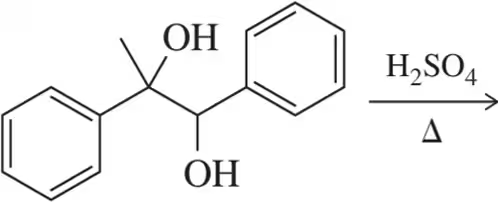
Predict the product of the following pinacol rearrangements.
(b) 
Verified step by step guidance1
Step 1: Understand the pinacol rearrangement mechanism. Pinacol rearrangement is an acid-catalyzed reaction where a 1,2-diol (vicinal diol) undergoes dehydration to form a ketone or aldehyde. The reaction involves carbocation formation and rearrangement.
Step 2: Identify the structure of the starting material. In this case, the compound is a pinacol (a 1,2-diol). Locate the hydroxyl groups (-OH) attached to adjacent carbon atoms in the molecule.
Step 3: Protonate one of the hydroxyl groups using the acid catalyst. This step converts the hydroxyl group into a better leaving group, forming water (H₂O). The protonated hydroxyl group will leave, generating a carbocation at the carbon atom where the hydroxyl group was attached.
Step 4: Analyze the stability of the carbocation. Carbocation rearrangement occurs to form the most stable carbocation. This often involves a hydride shift or alkyl group migration from an adjacent carbon atom to stabilize the positive charge.
Step 5: After the rearrangement, the carbocation reacts with water or loses a proton to form the final product, which is typically a ketone or aldehyde. The product structure depends on the specific arrangement of the starting material and the rearrangement pathway.

Verified video answer for a similar problem:
This video solution was recommended by our tutors as helpful for the problem above.
Video duration:
7mWas this helpful?
Key Concepts
Here are the essential concepts you must grasp in order to answer the question correctly.
Pinacol Rearrangement
The pinacol rearrangement is a chemical reaction involving the conversion of a pinacol (a 1,2-diol) into a ketone or aldehyde through a series of steps that include dehydration and rearrangement. This reaction typically occurs under acidic conditions, where the hydroxyl group is protonated, leading to the formation of a carbocation that can rearrange to form a more stable product.
Recommended video:
Guided course
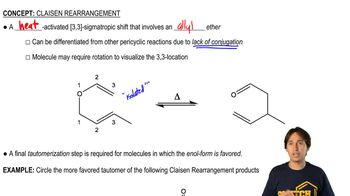
Definition of Claisen Rearrangement
Carbocation Stability
Carbocations are positively charged carbon species that play a crucial role in many organic reactions, including rearrangements. The stability of a carbocation is influenced by its degree (primary, secondary, tertiary) and the presence of electron-donating groups. More stable carbocations are favored during rearrangements, guiding the formation of the final product in reactions like the pinacol rearrangement.
Recommended video:
Guided course
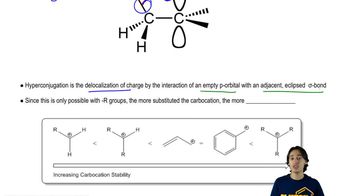
Determining Carbocation Stability
Dehydration Reaction
Dehydration reactions involve the removal of a water molecule from a compound, often leading to the formation of double bonds or new functional groups. In the context of the pinacol rearrangement, dehydration occurs after the formation of a carbocation, resulting in the loss of a water molecule and the generation of a carbonyl compound, which is the final product of the rearrangement.
Recommended video:
Guided course
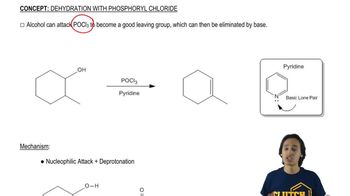
General Reaction of Dehydration with POCl3
Related Practice
Textbook Question
1
views
Textbook Question
Show a reaction coordinate diagram for the two processes in Figure 13.41 that rationalizes pathway B as the one that gives the major product.
<IMAGE>
1
views
Textbook Question
Suggest an alkene that, in two steps, could be converted into each of the following ketones. Each sequence should involve a pinacol rearrangement.
(c)
3
views
Textbook Question
The intermediates for the Swern oxidation, a reaction introduced in Section 13.9.4, are shown. Provide the arrow-pushing mechanism that rationalizes the formation of each intermediate and the final product(s).
1
views
Textbook Question
Predict the product of the following pinacol rearrangements.
(c)
Textbook Question
Identify two different alcohols that can be dehydrated (one without rearrangement) to form the alkene shown.