Ch. 13 - Alcohols, Ethers and Related Compounds: Substitution and Elimination
Mullins - Organic Chemistry: A Learner Centered Approach 1st Edition
Mullins1st EditionOrganic Chemistry: A Learner Centered ApproachISBN: 9780137566471Not the one you use?Change textbook
Chapter 12, Problem 75

Show an arrow-pushing mechanism that rationalizes formation of the two products. Which C―O bond will break first? Why?
Ether cleavage mechanism with HBr, showing cyclohexyl bromide and isopropyl bromide as products.

Verified step by step guidance
1
Identify the functional groups involved in the reaction. Look for any reactive sites such as carbonyl groups, alcohols, or ethers that might participate in the mechanism.
Determine the type of reaction taking place. Is it a substitution, elimination, or addition reaction? This will help in predicting the movement of electrons.
Consider the stability of intermediates formed during the reaction. The C―O bond that breaks first is likely the one that leads to the most stable intermediate.
Use curved arrows to show the movement of electrons. Start by breaking the C―O bond that leads to the formation of a stable carbocation or other intermediate. Ensure that the arrows accurately represent the flow of electrons from nucleophile to electrophile.
Predict the formation of products based on the intermediates. Consider any rearrangements or additional steps that might occur after the initial bond breaking, and use arrow-pushing to illustrate these transformations.

Verified video answer for a similar problem:

This video solution was recommended by our tutors as helpful for the problem above.
Video duration:
6m
Was this helpful?

Key Concepts

Here are the essential concepts you must grasp in order to answer the question correctly.

Arrow-Pushing Mechanism

Arrow-pushing is a technique used in organic chemistry to depict the movement of electrons during chemical reactions. It involves using curved arrows to show how electron pairs move from nucleophiles to electrophiles, facilitating bond formation and cleavage. Understanding this mechanism is crucial for predicting reaction outcomes and rationalizing product formation.
Recommended video:
Guided course
04:32
General Mechanism

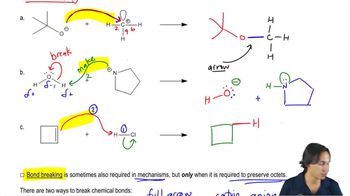
Bond Breaking in Organic Reactions

Bond breaking is a fundamental aspect of chemical reactions, where specific bonds are cleaved to form new products. In the context of C―O bonds, factors such as bond strength, steric hindrance, and electronic effects determine which bond breaks first. Analyzing these factors helps in predicting the sequence of bond cleavage in a reaction mechanism.
Recommended video:
Guided course
02:55
Identifying Bond Breaking

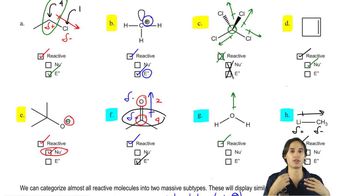
Electrophile and Nucleophile Interaction

Electrophiles are electron-deficient species that seek electrons, while nucleophiles are electron-rich species that donate electrons. Their interaction is central to many organic reactions, including the formation and breaking of bonds. Understanding the nature of these species and their role in a reaction helps in rationalizing the mechanism and predicting the products formed.
Recommended video:
Guided course
03:
Nucleophile or Electrophile