Ch. 13 - Alcohols, Ethers and Related Compounds: Substitution and Elimination
Mullins - Organic Chemistry: A Learner Centered Approach 1st Edition
Mullins1st EditionOrganic Chemistry: A Learner Centered ApproachISBN: 9780137566471Not the one you use?Change textbook
Chapter 12, Problem 76

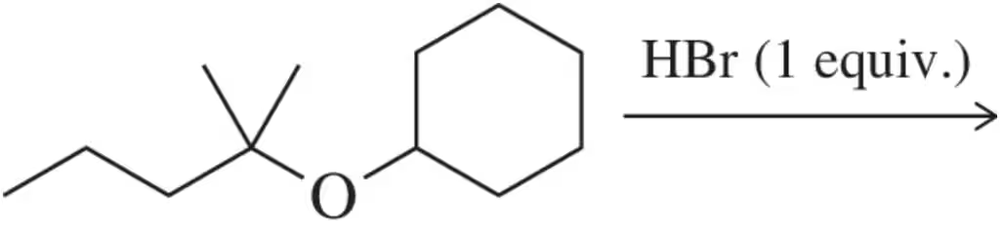
Predict the alcohol and haloalkane that will form upon reaction of the ether shown with one equivalent of HBr. [Hint: Think carefully about which side will become the halide.]
Chemical reaction of ether with HBr, showing ether cleavage to form alcohol and haloalkane.

Verified step by step guidance
1
Identify the structure of the ether. Ethers have the general formula R-O-R', where R and R' are alkyl groups. Determine the specific alkyl groups present in the given ether.
Understand the mechanism of ether cleavage by HBr. Ethers react with HBr through a nucleophilic substitution mechanism, where the ether oxygen is protonated, making it a better leaving group.
Consider the stability of the carbocations that would form if the ether were to cleave. The more stable carbocation will dictate which side of the ether will form the haloalkane.
Determine which side of the ether will form the alcohol. The side that does not form the carbocation will retain the oxygen, resulting in the formation of an alcohol.
Predict the products: Based on the stability analysis, predict the alcohol and haloalkane that will form. The more stable carbocation side will form the haloalkane, and the other side will form the alcohol.

Verified video answer for a similar problem:

This video solution was recommended by our tutors as helpful for the problem above.
Video duration:
3m
Was this helpful?

Key Concepts

Here are the essential concepts you must grasp in order to answer the question correctly.

Ether Cleavage

Ether cleavage is a reaction where an ether is split into two products, typically an alcohol and a haloalkane, upon treatment with a strong acid like HBr. The reaction involves the protonation of the ether oxygen, making it susceptible to nucleophilic attack, leading to the formation of the two products.
Recommended video:
1:45
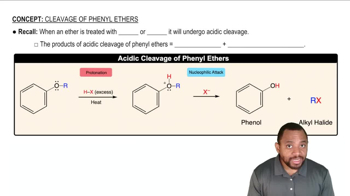
Cleavage of Phenyl Ethers Concept 1

Regioselectivity in Ether Cleavage

Regioselectivity in ether cleavage refers to the preference for breaking the C-O bond on one side of the ether over the other. This is influenced by factors such as steric hindrance and the stability of the resulting carbocation. Typically, the bond that leads to the more stable carbocation is cleaved, forming the haloalkane.
Recommended video:
1:45
Cleavage of Phenyl Ethers Concept 1

Carbocation Stability

Carbocation stability is crucial in determining the outcome of reactions involving carbocations. Stability is influenced by factors such as the number of alkyl groups attached to the positively charged carbon, resonance, and hyperconjugation. More substituted carbocations are generally more stable, guiding the regioselectivity of reactions like ether cleavage.
Recommended video:
Guided course
05:58
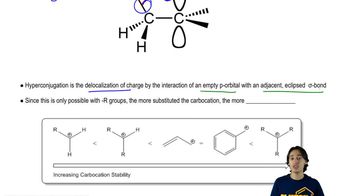
Determining Carbocation Stability