Ch. 13 - Alcohols, Ethers and Related Compounds: Substitution and Elimination
Mullins - Organic Chemistry: A Learner Centered Approach 1st Edition
Mullins1st EditionOrganic Chemistry: A Learner Centered ApproachISBN: 9780137566471Not the one you use?Change textbook
Chapter 12, Problem 30

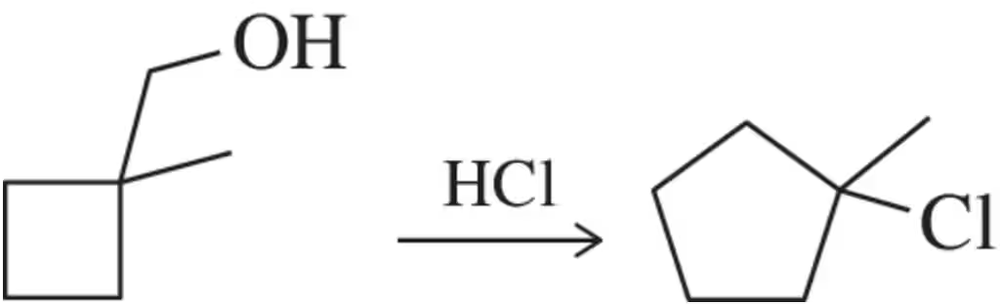
Provide an arrow-pushing mechanism that rationalizes the outcome of the reaction shown.
Chemical reaction diagram showing an alcohol converting to a chlorinated compound with an arrow-pushing mechanism.

Verified step by step guidance
1
Step 1: Protonation of the alcohol group - The hydroxyl group (-OH) on the cyclobutyl ring is protonated by HCl, forming a positively charged oxonium ion. This step increases the leaving group ability of the hydroxyl group.
Step 2: Formation of a carbocation - The protonated hydroxyl group leaves as water (H2O), generating a cyclobutyl carbocation. This carbocation is highly strained due to the four-membered ring.
Step 3: Ring expansion - To relieve the ring strain, the cyclobutyl carbocation undergoes a ring expansion via a 1,2-hydride shift or a 1,2-alkyl shift, forming a more stable cyclopentyl carbocation.
Step 4: Nucleophilic attack by chloride ion - The chloride ion (Cl⁻) from HCl acts as a nucleophile and attacks the cyclopentyl carbocation, forming the final product, cyclopentyl chloride.
Step 5: Verify the product - The final product is a cyclopentane ring with a chlorine atom attached to the carbon that was originally part of the carbocation.

Verified video answer for a similar problem:

This video solution was recommended by our tutors as helpful for the problem above.
Was this helpful?

Key Concepts

Here are the essential concepts you must grasp in order to answer the question correctly.

Arrow-Pushing Mechanism

The arrow-pushing mechanism is a method used in organic chemistry to illustrate the movement of electrons during chemical reactions. Arrows indicate the direction of electron flow, showing how bonds are formed and broken. This visual representation helps chemists understand reaction pathways and predict the products formed in a reaction.
Recommended video:
Guided course
04:32
General Mechanism

Nucleophiles and Electrophiles

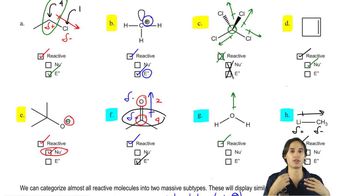
Nucleophiles are species that donate an electron pair to form a chemical bond, while electrophiles are electron-deficient species that accept an electron pair. Understanding the roles of nucleophiles and electrophiles is crucial for predicting the outcome of reactions, as they determine how reactants interact and what products are formed.
Recommended video:
Guided course
03:
Nucleophile or Electrophile

Reaction Mechanisms

A reaction mechanism is a step-by-step description of the process by which reactants transform into products. It includes details about the intermediates formed, the transition states, and the energy changes throughout the reaction. Analyzing the mechanism allows chemists to understand the kinetics and thermodynamics of the reaction, providing insights into how to optimize conditions for desired outcomes.
Recommended video:
Guided course
02:16
Heck Reaction Mechanism