Ch. 13 - Alcohols, Ethers and Related Compounds: Substitution and Elimination
Mullins - Organic Chemistry: A Learner Centered Approach 1st Edition
Mullins1st EditionOrganic Chemistry: A Learner Centered ApproachISBN: 9780137566471Not the one you use?Change textbook
Chapter 12, Problem 34b

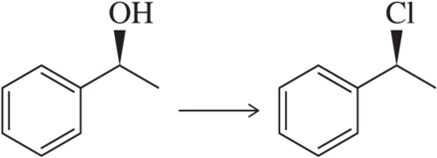
Identify the reagent that should be used to obtain each stereochemical outcome shown.
(b) Chemical reaction: benzyl alcohol with OH group converts to benzyl chloride with Cl group, retaining stereochemistry.

Verified step by step guidance
1
Step 1: Understand the stereochemical outcome desired. Determine if the reaction requires a syn or anti addition, retention or inversion of configuration, or if it involves a specific stereochemistry such as E/Z or R/S.
Step 2: Identify the type of reaction that can lead to the desired stereochemical outcome. Common reactions include hydrogenation, halogenation, hydroboration-oxidation, and epoxidation, each with specific stereochemical implications.
Step 3: Consider the starting material and its functional groups. The presence of double bonds, alcohols, or other functional groups will influence the choice of reagent.
Step 4: Select the appropriate reagent based on the reaction type and starting material. For example, syn addition might require reagents like H2 with a catalyst for hydrogenation, while anti addition might use Br2 in a halogenation reaction.
Step 5: Verify the stereochemical outcome by considering the mechanism of the reaction. Ensure that the chosen reagent will lead to the desired stereochemistry by analyzing the transition states and intermediates involved.

Verified video answer for a similar problem:

This video solution was recommended by our tutors as helpful for the problem above.
Video duration:
1m
Was this helpful?

Key Concepts

Here are the essential concepts you must grasp in order to answer the question correctly.

Stereochemistry

Stereochemistry involves the study of the spatial arrangement of atoms in molecules and its impact on chemical reactions. Understanding stereochemistry is crucial for predicting the outcome of reactions, especially when different stereoisomers can form. It includes concepts like chirality, enantiomers, and diastereomers, which are essential for determining the stereochemical outcome of a reaction.
Recommended video:
1:38
Polymer Stereochemistry Concept 1

Reagents and Reaction Mechanisms

Reagents are substances used to cause a chemical reaction, and understanding their role is key to predicting reaction outcomes. Different reagents can lead to different stereochemical configurations by influencing the reaction mechanism, such as nucleophilic substitution or elimination. Knowing the specific reagents and their effects on molecular structure helps in selecting the right one for desired stereochemical results.
Recommended video:
Guided course
06:50
Jones Reagent Mechanism

Stereoselective Reactions

Stereoselective reactions are those where a particular stereoisomer is preferentially formed over others. These reactions are influenced by the choice of reagents and conditions, which can favor the formation of one stereoisomer due to factors like steric hindrance or electronic effects. Understanding how to control these reactions is essential for achieving specific stereochemical outcomes in synthesis.
Recommended video:
Guided course
05:09
Heck Reaction