Ch. 13 - Alcohols, Ethers and Related Compounds: Substitution and Elimination
Mullins - Organic Chemistry: A Learner Centered Approach 1st Edition
Mullins1st EditionOrganic Chemistry: A Learner Centered ApproachISBN: 9780137566471Not the one you use?Change textbook
Chapter 12, Problem 63b(ii)

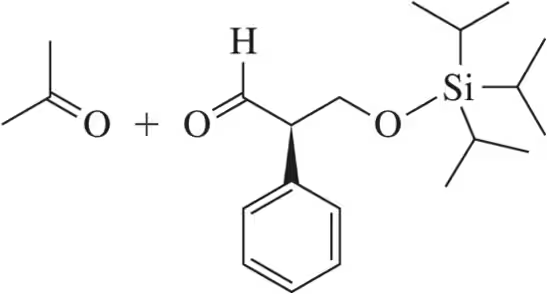
Propose a synthesis of the carbonyl(s) using the (ii) dihydroxylation/periodic acid cleavage pathways.
(b) Chemical structure showing a carbonyl compound with a benzene ring and a silyl ether group.

Verified step by step guidance
1
Step 1: Begin by identifying the starting material that can undergo dihydroxylation. Typically, alkenes are suitable candidates for this transformation.
Step 2: Perform dihydroxylation on the alkene using a reagent such as osmium tetroxide (OsO₄) or potassium permanganate (KMnO₄) to convert the alkene into a vicinal diol. This step introduces two hydroxyl groups across the double bond.
Step 3: Once the vicinal diol is formed, the next step is to cleave the diol using periodic acid (HIO₄). Periodic acid selectively cleaves the C-C bond between the two hydroxyl groups, resulting in the formation of two carbonyl compounds.
Step 4: Analyze the structure of the resulting carbonyl compounds. Depending on the initial alkene structure, you may obtain aldehydes or ketones as products.
Step 5: Consider any additional steps or modifications needed to achieve the desired carbonyl compound, such as adjusting the alkene structure or using protective groups if necessary.

Verified video answer for a similar problem:

This video solution was recommended by our tutors as helpful for the problem above.
Video duration:
7m
Was this helpful?

Key Concepts

Here are the essential concepts you must grasp in order to answer the question correctly.

Dihydroxylation

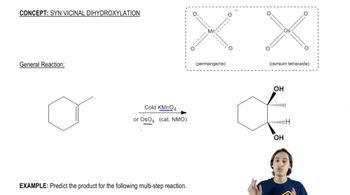
Dihydroxylation is a chemical reaction that involves the addition of two hydroxyl groups (OH) across a double bond in an alkene, resulting in a vicinal diol. This reaction can be achieved using reagents like osmium tetroxide (OsO4) or potassium permanganate (KMnO4). The process is stereospecific, typically yielding syn diols, where both hydroxyl groups add to the same side of the double bond.
Recommended video:
Guided course
03:50
General properties of syn vicinal dihydroxylation.

Periodic Acid Cleavage

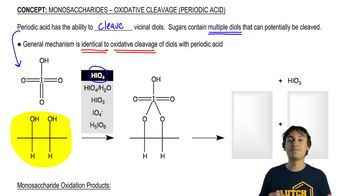
Periodic acid cleavage is a reaction where vicinal diols are cleaved by periodic acid (HIO4) to form two carbonyl compounds, such as aldehydes or ketones. This reaction is useful for breaking down complex molecules into simpler carbonyl fragments. The mechanism involves the formation of a cyclic periodate ester, which then decomposes to yield the carbonyl products.
Recommended video:
Guided course
06:41
Monosaccharides - Oxidative Cleavage

Carbonyl Compounds

Carbonyl compounds are organic molecules that contain a carbon-oxygen double bond (C=O), such as aldehydes and ketones. They are highly reactive due to the polar nature of the carbonyl group, making them key intermediates in many organic synthesis pathways. Understanding their reactivity and the types of reactions they undergo is crucial for designing synthetic routes in organic chemistry.
Recommended video:
Guided course
01:40
Defining meso compounds.